
Description
NR507 Week 5 Discussion Choose Your Own Pathophysiology Adventure: Part 2 of 3
Discussion
Purpose
The purpose of the graded collaborative discussions is to engage faculty and students in an interactive dialogue to assist the student in appraising data to improve population health outcomes. Meaningful dialogue among faculty and students fosters the development of a learning community as ideas, perspectives, and knowledge are shared. This discussion will support the professional formation of the nurse practitioner (NP) role.
Course Outcomes
This discussion enables the student to meet the following course outcomes:
- CO 1: Analyze pathophysiologic mechanisms associated with selected disease states across the lifespan.
- CO 2: Examine the way in which homeostatic, adaptive, and compensatory physiological mechanisms can be supported and/or altered through specific therapeutic interventions across the lifespan.
- CO 3: Distinguish risk factors associated with selected disease states across the lifespan.
- CO 4: Integrate advanced pathophysiological concepts in the diagnosis and treatment of health problems in selected populations.
- CO 5: Relate research findings to the management of patients with complex pathophysiologic dysfunction.
Due Date
Initial posts are due to the discussion forum by Wednesday at 11:59 p.m. MT. Instructor and peer responses are due by Sunday at 11:59 p.m. MT. Students must post on a minimum of two separate days. A 10% late penalty will be imposed for discussions posted after the deadline Wednesday at 11:59 p.m. MT, regardless of the number of days late. NOTHING will be accepted after 11:59 p.m. MT on Sunday (i.e., the student will receive an automatic 0).
Total Points Possible: 50
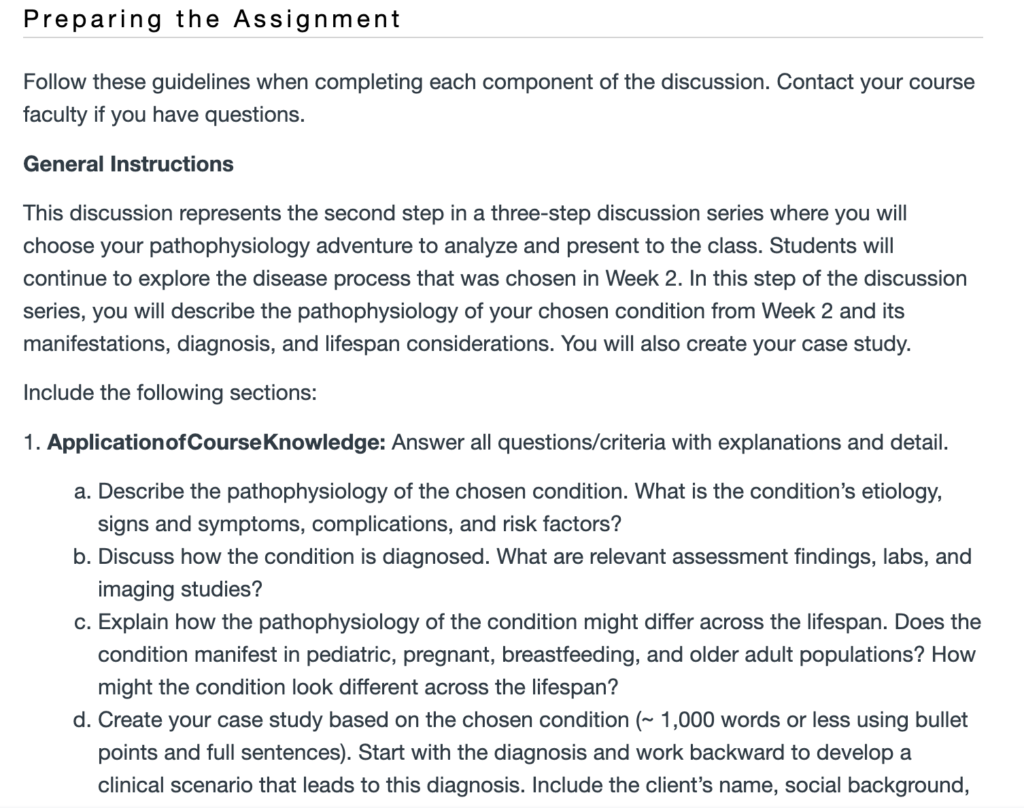
Preparing the Assignment
Follow these guidelines when completing each component of the discussion. Contact your course faculty if you have questions.
General Instructions
This discussion represents the second step in a three-step discussion series where you will choose your pathophysiology adventure to analyze and present to the class. Students will continue to explore the disease process that was chosen in Week 2. In this step of the discussion series, you will describe the pathophysiology of your chosen condition from Week 2 and its manifestations, diagnosis, and lifespan considerations. You will also create your case study.
Include the following sections:
1. Application of Course
- Describe the pathophysiology of the chosen condition. What is the condition’s etiology, signs and symptoms, complications, and risk factors?
- Discuss how the condition is diagnosed. What are relevant assessment findings, labs, and imaging studies?
- Explain how the pathophysiology of the condition might differ across the lifespan. Does the condition manifest in pediatric, pregnant, breastfeeding, and older adult populations? How might the condition look different across the lifespan?
- Create your case study based on the chosen condition (~ 1,000 words or less using bullet points and full sentences). Start with the diagnosis and work backward to develop a clinical scenario that leads to this diagnosis. Include the client’s name, social background, symptoms, lab results, medical or surgical history, and other relevant details.
2. Integration of Evidence: Integrate relevant scholarly sources as defined by program expectations:
- Cite a scholarly source in the initial post.
- Cite a scholarly source in one faculty response post.
- Cite a scholarly source in one peer post.
- Accurately analyze, synthesize, and/or apply principles from evidence with no more than one short quote (15 words or less) for the week.
- Include a minimum of two different scholarly sources per week. Cite all references and provide references for all citations.
3. Engagement in Meaningful Dialogue: Engage peers and faculty by asking questions and offering new insights, applications, perspectives, information, or implications for practice.
- Peer Response: Respond to at least one peer on a condition other than the one you selected.
- Faculty Response: Respond to at least one faculty post.
- Communicate using respectful, collegial language and terminology appropriate to advanced nursing practice.
4. Professionalism in Communication: Communicate with minimal errors in English grammar, spelling, syntax, and punctuation.
5. Reference Citation: Use current APA format to format citations and references free of errors.
6. Wednesday Participation Requirement: Provide a
7. Total Participation Requirement: Provide at least three substantive posts (one to the initial question or topic, one to a student peer, and one to a faculty question) on two different days during the week.
**To view the grading criteria/rubric, please click on the 3 dots in the box at the end of the solid gray bar above the discussion board title and then Show Rubric.
Solution:NR507 Week 5 Discussion Choose Your Own Pathophysiology Adventure: Part 2 of 3
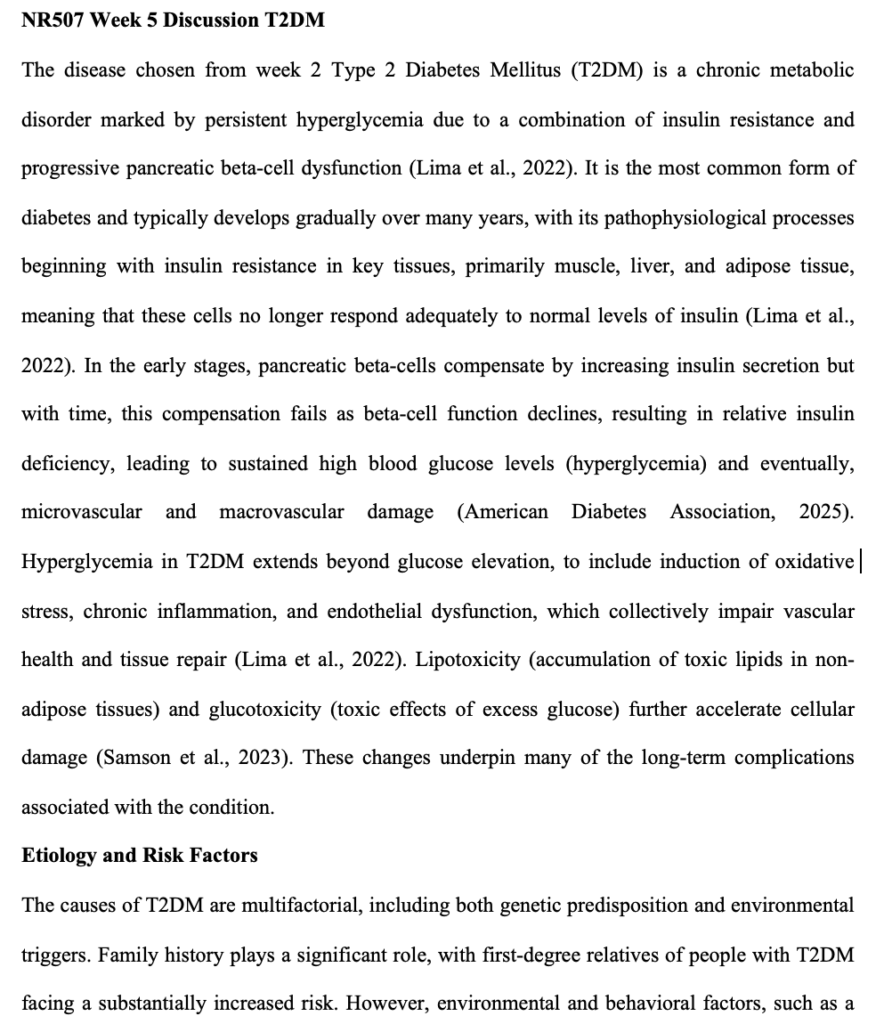
NR507 Week 5 Discussion T2DM
The disease chosen from week 2 Type 2 Diabetes Mellitus (T2DM) is a chronic metabolic disorder marked by persistent hyperglycemia due to a combination of insulin resistance and progressive pancreatic beta-cell dysfunction (Lima et al., 2022). It is the most common form of diabetes and typically develops gradually over many years, with its pathophysiological processes beginning with insulin resistance in key tissues, primarily muscle, liver, and adipose tissue, meaning that these cells no longer respond adequately to normal levels of insulin (Lima et al., 2022). In the early stages, pancreatic beta-cells compensate by increasing insulin secretion but with time, this compensation fails as beta-cell function declines, resulting in relative insulin deficiency, leading to sustained high blood glucose levels (hyperglycemia) and eventually, microvascular and macrovascular damage (American Diabetes Association, 2025). Hyperglycemia in T2DM extends beyond glucose elevation, to include induction of oxidative stress, chronic inflammation, and endothelial dysfunction, which collectively impair vascular health and tissue repair (Lima et al., 2022). Lipotoxicity (accumulation of toxic lipids in non-adipose tissues) and glucotoxicity (toxic effects of excess glucose) further accelerate cellular damage (Samson et al., 2023). These changes underpin many of the long-term complications associated with the condition.
Etiology and Risk Factors
The causes of T2DM are multifactorial, including both genetic predisposition and environmental triggers. Family history plays a significant role, with first-degree relatives of people with T2DM facing a substantially increased risk. However, environmental and behavioral factors, such as a sedentary lifestyle, high-calorie diets rich in processed carbohydrates, and obesity (especially
Add to Cart to get full solution


Reviews
There are no reviews yet.