
Description
NR565 Week 4 Midterm Exam
NR565 Week 4 Midterm Exam
The NP is managing a patient that is newly prescribed spironolactone (Aldactone) for heart failure. Which patient teaching point is MOST appropriate based on the drug’s mechanism of action?
Answers: A – D
- “You may notice increased urination within the first hour after taking your dose.”
B. “This medication will cause rapid fluid loss, so weigh yourself twice daily.”
C. “This medication may increase your potassium levels, so avoid salt substitutes containing potassium.” ✅
D. “Take this medication at night to enhance its immediate diuretic effect.”
Which of the following statements best describes full prescriptive authority?
Answers: A – D
- The authority to prescribe schedule I drugs without restrictions
B. The ability to prescribe only non-controlled substances under physician supervision
C. The right to prescribe medications only with oversight from a physician
D. The legal right to prescribe independently and without limitation ✅
Which of the following is an example of a drug acting as an antagonist?
Answers: A – D
- Acetylcholine stimulating muscarinic receptors in the GI tract
B. Naloxone blocking opioid receptors to reverse respiratory depression ✅
C. Dobutamine activating β1 receptors to increase heart rate
D. Morphine binding to μ-opioid receptors to reduce pain perception
A neonate is prescribed a drug that is eliminated primarily via renal excretion. Which adjustment is MOST appropriate to avoid toxicity?
Answers: A – D
- Administer the drug orally instead of intravenously
B. Increase the frequency of administration
C. Use a sustained-release formulation
D. Reduce the dose or increase the dosing interval ✅
Which of the following is a pathologic effect of aldosterone seen in conditions such as heart failure?
Answers: A – D
- Promotion of cardiac fibrosis and vascular remodeling ✅
B. Decreased blood pressure through sodium loss
C. Stimulation of vasodilation in vascular smooth muscle
D. Enhanced baroreceptor sensitivity
Which of the following is a correct statement about renin-angiotensin-aldosterone system (RAAS) inhibitors across different life stages?
Answers: A – D
- Losartan (Cozaar) was associated with a 25% decrease in stroke risk in adults aged 55 to 80 years in clinical trials ✅
B. ACE inhibitors are contraindicated in children of all ages
C. RAAS inhibitors are recommended during pregnancy, especially in the third trimester
D. There is strong evidence supporting safety of RAAS inhibitors during breastfeeding
A postmenopausal woman is prescribed calcitonin (Miacalcin) for osteoporosis. What is the therapeutic goal of calcitonin in this patient?
Answers: A – D
- To increase parathyroid hormone secretion to maintain calcium balance
B. To stimulate bone formation and increase bone density
C. To inhibit osteoclast activity and reduce bone resorption ✅
D. To enhance calcium absorption from the gastrointestinal tract
Which of the following BEST explains why recommending cannabis use requires caution, especially for young people or those with mental health conditions?
Answers: A – D
- Cannabis is completely safe when used in edible form or low-THC strains
B. Cannabis has no therapeutic potential and is only harmful to behavioral health
C. Cannabis use has been proven to directly cause mental illness in all users
D. Cannabis use is associated with an increased risk of psychosis and other mental health disorders ✅
Which of the following is a widely recommended strategy to reduce adverse drug reactions in older adults?
Answers: A – D
- Avoid monitoring drug levels unless symptoms appear
B. Begin drug therapy at standard adult dosing levels
C. Use complex medication regimens to ensure full therapeutic coverage
D. Initiate therapy at a low dose and increase gradually ✅
The NP is volunteering at a community health event where naloxone (Narcan) kits are being distributed to individuals at risk for opioid overdose. A participant asks what to do if the first naloxone (Narcan) nasal spray dose does not revive someone. How should the NP respond to the participant?
Answers: A – D
- Administer an additional dose every 2 to 3 minutes until emergency help arrives ✅
B. Give an oral dose of naloxone if the person doesn’t respond to the nasal spray
C. Attempt to dilute the nasal spray with water and give it again
D. Wait 10 minutes before giving a second dose to allow time for absorption
The NP is reviewing safe opioid prescribing practices for a patient with chronic, noncancer pain. Which of the following statements BEST reflects a key principle in initiating opioid therapy?
Answers: A – D
- Long-acting opioids should be used initially to reduce the need for frequent dosing
B. Immediate-release (IR) opioids should be used first to reduce the risk of overdose ✅
C. Standardized opioid doses are sufficient for most adult patients and simplify prescribing
D. Nonopioid therapies should be discontinued once opioids are started to avoid drug interactions
Which of the following is the MOST common cause of adverse drug reactions (ADRs) in older adults?
Answers: A – D
- Reduced renal drug excretion ✅
B. Increased gastric pH
C. Slowed hepatic metabolism
D. Decreased serum albumin
A patient is taking ezetimibe and a bile acid sequestrant. What administration schedule should be recommended to minimize the interaction between these drugs?
Answers: A – D
- Administer both drugs separately at bedtime
B. Administer ezetimibe and sequestrant simultaneously
C. Administer ezetimibe 4 hours after the sequestrant ✅
D. Administer sequestrant 1 hour before ezetimibe
What is the typical onset and duration of diuretic action after oral administration of furosemide (Lasix)?
Answers: A – D
- Onset 15 minutes; duration 24 hours
B. Onset 30 minutes; duration 4 hours
C. Onset 60 minutes; duration 6–8 hours ✅
D. Onset 2 hours; duration 12 hours
Which of the following BEST describes how Class II β-adrenergic blocking agents affect the heart?
Answers: A – D
- They increase calcium entry and enhance contractility in cardiac tissues
B. They block sodium channels to prevent phase 0 depolarization
C. They slow AV node conduction and decrease atrial and ventricular contractility ✅
D. They stimulate the SA node to increase heart rate
An 82-year-old patient has been prescribed diphenhydramine (Benadryl) for allergies. Which of the following is the MOST appropriate clinical concern based on Beers Criteria?
Answers: A – D
- Inhibition of CYP450 enzymes reducing drug metabolism
B. Risk of drug-induced liver injury
C. High potential for gastrointestinal bleeding
D. Anticholinergic effects including confusion and urinary retention ✅
A patient with chronic stable angina is prescribed ranolazine (Ranexa). Which of the following characteristics BEST distinguishes this medication from other antianginal agents?
Answers: A – D
- It primarily reduces heart rate and blood pressure within minutes of taking it
B. It reduces intracellular sodium and calcium without significantly affecting heart rate or blood pressure ✅
C. It directly increases myocardial oxygen supply and reduces peripheral vascular resistance
D. It causes coronary vasodilation to relieve anginal pain in combination with nitroglycerin
A 56-year-old male with a history of chronic gout presents for management of recurrent flares. He also has a past medical history of stage 3 chronic kidney disease (eGFR 45 mL/min) and hypertension controlled with hydrochlorothiazide (Microzide). Which of the following is the most appropriate initial pharmacologic therapy to lower his uric acid levels long-term?
Answers: A – D
- Indomethacin (Indocin)
B. Allopurinol (Zyloprim) ✅
C. Colchicine (Colcrys)
D. Probenecid (Benemid)
A patient is prescribed tramadol for moderate to moderately severe pain. The patient is currently taking an SSRI for depression. Which precaution should be taken when prescribing tramadol to a patient taking an SSRI?
Answers: A – D
- Prescribe a benzodiazepine with tramadol to reduce the risk of adverse effects
B. Monitor for signs of serotonin syndrome, as the combination increases the risk ✅
C. Discontinue the SSRI before starting tramadol to avoid reduced pain control
D. No precautions are necessary; tramadol and SSRIs are commonly prescribed together
The NP is reviewing the chart of a patient who is taking a medication known to cause bone marrow suppression. Which monitoring strategy is MOST appropriate to help detect an adverse drug reaction early?
Answers: A – D
- Yearly bone marrow biopsy
B. Liver enzyme tests (AST and ALT) every 6 months
C. Routine blood pressure checks
D. Regular complete blood cell counts (CBC) ✅
Why is it important for the NP to check for drug interactions, including those involving over the counter and herbal products before prescribing a new medication?
Answers: A – D
- It allows the NP to avoid responsibility by referring the patient to a pharmacist
B. It helps simplify the prescribing process by focusing only on prescription drugs
C. It helps prevent adverse effects and ensures safe medication use ✅
D. It ensures the patient receives the most expensive medication available
A patient with newly diagnosed rheumatoid arthritis is prescribed Meloxicam (Mobic) for symptom relief. Based on standard dosing guidelines, which of the following instructions would be MOST appropriate for the NP to give?
Answers: A – D
- Take Meloxicam (Mobic) only during flareups, as needed
B. Take 15 mg of Meloxicam (Mobic) once daily ✅
C. Take 200 mg of Meloxicam (Mobic) twice daily to control inflammation
D. Take 5 mg of Meloxicam (Mobic) three times a day with meals
Which of the following statements BEST reflects the current understanding of the role of colchicine (Colcrys) in gout management?
Answers: A – D
- Colchicine (Colcrys) is only approved for use during acute gouty episodes
B. Colchicine (Colcrys) lowers uric acid levels by increasing renal excretion
C. Colchicine (Colcrys) is the preferred first-line treatment for gout due to its minimal side effects
D. Colchicine (Colcrys) is used both to treat acute gout attacks and to prevent future flare-ups ✅
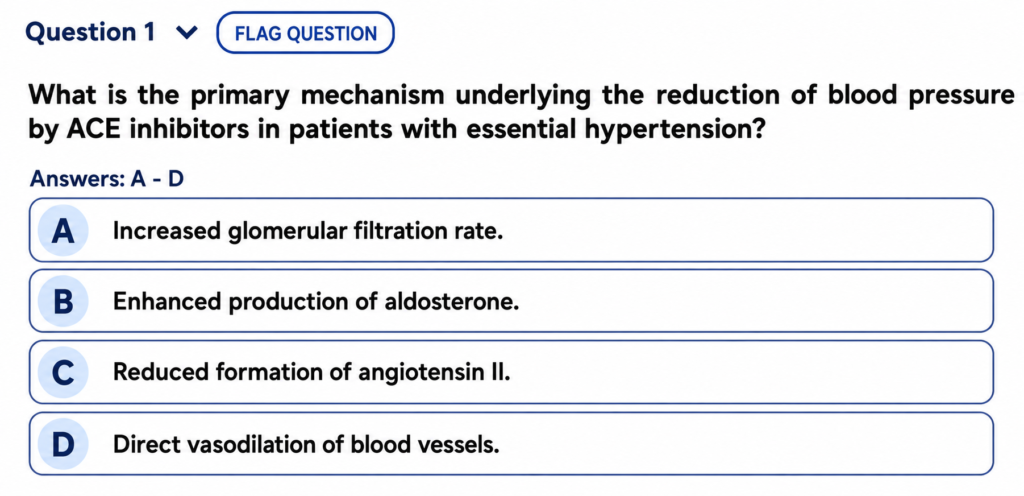
What is the primary mechanism underlying the reduction of blood pressure by ACE inhibitors in patients with essential hypertension?
Answers: A – D
- Directly stimulating beta-adrenergic receptors to decrease heart rate and cardiac output
B. Blocking calcium channels to induce arterial vasodilation
C. Inhibiting the conversion of angiotensin I to angiotensin II, leading to vasodilation and reduced aldosterone ✅
D. Increasing sodium and water reabsorption in the renal tubules




Reviews
There are no reviews yet.