Description
NR509 Week 4 Midterm Exam
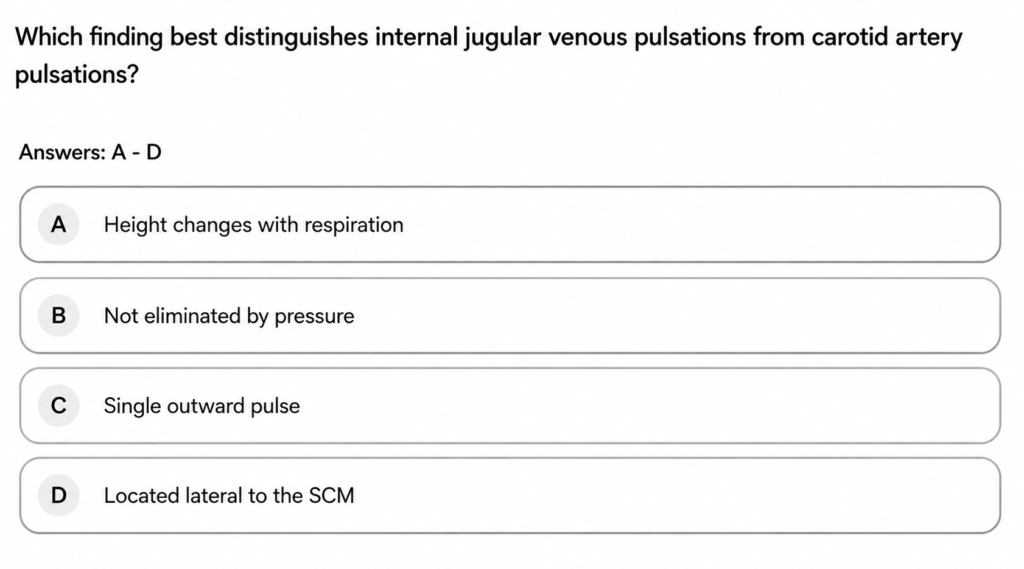
The NP is conducting a cardiac physical examination to assess for jugular venous distention. What is the MOST appropriate position for this assessment?
Answers: A – D
- Prone
- Sitting leaning forward after full exhalation
- Supine with head of bed elevated to 30 degrees ✅
- Left lateral decubitus
✔️ Correct answer: C. Supine with head of bed elevated to 30 degrees
Which of the following findings constitutes jugular venous distention (JVD) during a physical examination?
Answers: A – D
- Internal jugular vein distention observed above 3 cm from the sternal angle with the head of the bed elevated to 30–45 degrees ✅
- Visible pulsations of the internal jugular vein at the sternal notch with the patient seated upright at 90 degrees
- External jugular vein collapse when the patient is positioned at a 45-degree angle
- Carotid artery pulsation visible just above the clavicle with the patient lying flat
✔️ Correct answer: A. Internal jugular vein distention observed above 3 cm from the sternal angle with the head of the bed elevated to 30–45 degrees
During a physical examination of a patient, the NP notes a large, well-defined, flat-topped lesion on the elbow. The lesion is raised and measures about 2 cm in diameter, and it appears to have formed by the coalescence of smaller, elevated spots. How should the NP describe this lesion based on the physical exam findings?
Answers: A – D
- Papule
- Nodule
- Plaque ✅
- Macule
✔️ Correct answer: C. Plaque
A 44-year-old female presents for follow-up care. She was diagnosed with systemic lupus erythematosus 6 months ago. Since her diagnosis, she has been minimally compliant with medications. The NP is using the FIFE model to guide the encounter. What does FIFE stand for?
Answers: A – D
- Function, Illness, Family, and Examination
- Feelings, Investigation, Findings, and Education
- Feelings, Ideas, Function, and Expectations ✅
- Fear, Impact, Facts, and Evaluation
✔️ Correct answer: C. Feelings, Ideas, Function, and Expectations
When evaluating pulsus paradoxus, which measurement difference confirms the finding?
Answers: A – D
- ≥10 mm Hg drop during inspiration ✅
- ≥5 mm Hg drop during inspiration
- Constant systolic pressure throughout the cycle
- Increase in diastolic pressure during expiration
✔️ Correct answer: A. ≥10 mm Hg drop during inspiration
A 42-year-old male complains of pain in his left leg. He does not remember injuring his leg; however, he notes that there is a small wound on the lateral aspect of his mid-shin. Upon examination, some mild erythema surrounding the wound and flat, nonpalpable red streaks progressing up his leg are noted. What do these streaks likely represent?
Answers: A – D
- Dilated veins
- Occluded arterial vessels
- Draining lymphatic channels ✅
- Thrombus
✔️ Correct answer: C. Draining lymphatic channels
Which of the following best reflects the practice of cultural humility in clinical encounters?
Answers: A – D
- Using your personal experience to guide the patient toward the best medical decision
- Prioritizing biomedical knowledge over a patient’s personal beliefs when conflicts arise
- Learning the health beliefs and customs of every cultural group before clinical practice
- Engaging in self-reflection and respectful communication to build collaborative partnerships with patients ✅
✔️ Correct answer: D. Engaging in self-reflection and respectful communication to build collaborative partnerships with patients
A patient presents with a mole on the back that has recently changed in appearance. Upon physical examination, the mole is asymmetrical, has irregular borders, and features varying colors. It is elevated, firm to palpation, and has been growing progressively over the past few weeks. Based on these findings and using the ABCDE method, how should the NP describe this lesion?
Answers: A – D
- A benign seborrheic keratosis
- A hypertrophic scar
- A suspicious lesion for melanoma ✅
- A benign melanocytic nevus
✔️ Correct answer: C. A suspicious lesion for melanoma
Which of the following is not one of the four cardinal techniques of physical examination?
Answers: A – D
- Palpation
- Inspection
- Evaluation ✅
- Percussion
✔️ Correct answer: C. Evaluation
During a routine eye examination with a penlight, the NP observes a gray opacity in the pupil of an older adult patient. When the pupil is widely dilated, the gray area is surrounded by a black rim. Which of the following findings is most consistent with this observation?
Answers: A – D
- Acute angle-closure glaucoma
- Subconjunctival hemorrhage
- Nuclear cataract ✅
- Corneal arcus
What is the purpose of using open-ended questions at the beginning of a patient interview?
Answers: A – D
- To speed up the history-taking process
- To limit irrelevant information
- To guide the patient to a specific diagnosis
- To allow the patient to express their concerns freely in their own words ✅
A 77-year-old male is experiencing progressive shortness of breath and dizziness. The patient undergoes cardiac catheterization, and the systolic blood pressure measured in the left ventricle is 180 mm Hg, while the systolic blood pressure measured in the aorta is 140 mm Hg. The patient is most likely experiencing symptoms related to what valve condition?
Answers: A – D
- Aortic stenosis ✅
- Mitral regurgitation
- Tricuspid regurgitation
- Mitral stenosis
The NP is performing an eye examination. Which of the following physical assessment findings are expected as part of the normal aging process?
Answers: A – D
- Decreased near vision (presbyopia) ✅
- Unequal pupil sizes (anisocoria)
- Sudden onset of floaters and flashes
- Loss of peripheral vision
A newborn has an embryologic defect affecting the aortic valve. What additional valve is most likely to be affected?
Answers: A – D
- P valve
- Mitral valve
- Pulmonic valve ✅
- Tricuspid valve
A 40-year-old male presents with daily headaches that have worsened over the past several months. The headaches are worse with lying down and persist throughout the day. On funduscopic examination of the right eye, the NP notes that the disk edge is indistinct, and the veins do not pulsate. What medical condition is most closely associated with these physical assessment findings?
Answers: A – D
- Increased intracranial pressure ✅
- Cataracts
- Detached retina
- Acute angle glaucoma
A NP student is examining a patient with a structurally normal heart. The student is having difficulty auscultating the splitting of the second heart sound. At what area on the patient’s chest would the student have the best opportunity of hearing this sound?
Answers: A – D
- Second intercostal space at the right sternal border
- Second and third intercostal space at the left sternal border ✅
- Fifth intercostal space at the midclavicular line
- Apex
A 59-year-old male presents with multiple episodes of epigastric pain. He mentions that his father passed away from pancreatic cancer at the age of 52 and states, “my father’s pain was just like mine is now.” The NP responds by saying, “your pain is just like your father’s before he passed away.” Which interviewing technique is the NP using?
Answers: A – D
- Confrontation
- Restating for emphasis ✅
- Reflection
- Providing reassurance
Which physical exam finding is most consistent with pleural effusion?
Answers: A – D
- Increased tactile fremitus
- Hyperresonance to percussion
- Decreased diaphragmatic excursion
- Dullness to percussion ✅
Which of the following statements best distinguishes between subjective and objective information in clinical documentation?
Answers: A – D
- Subjective information consists of measurable data from the physical exam, while objective information includes client-reported symptoms
- Subjective information includes laboratory results and imaging findings, while objective information is limited to the physical exam
- Subjective information includes the client’s reported symptoms and concerns, while objective information includes physical exam findings and diagnostic test results ✅
- Subjective information is more reliable than objective information because it comes directly from the client
A 25-year-old female comes to your clinic for evaluation of fatigue. As part of the physical examination, the NP listens to her heart and hears a murmur only at the cardiac apex. Which valve is most likely to be involved, based on the location of the murmur?
Answers: A – D
- Pulmonic murmur
- Diastolic murmur
- Tricuspid murmur
- Mitral murmur ✅
What maneuver aids in assessing thyroid movement during inspection and palpation?
Answers: A – D
- Asking the patient to hold their breath
- Having the patient close their eyes tightly
- Asking the patient to take a deep breath and cough
- Asking the patient to sip and swallow water ✅
Which of the following is a classic feature of Broca’s aphasia?
Answers: A – D
- Slow, nonfluent speech with preserved comprehension ✅
- Fluent but nonsensical speech with impaired comprehension
- Tangential speech with shifting, loosely connected topics
- Repetition of words and phrases of others
When taking a health history for a patient presenting with respiratory symptoms, which of the following is the most important aspect to focus on to identify life-threatening conditions?
Answers: A – D
- Ability to speak in full sentences and use of accessory muscles ✅
- Past medical history without considering social or environmental factors
- Family history of respiratory disease
- Dietary habits and exercise routine
A NP is caring for a patient with depression. The patient reports not feeling suicidal, although still depressed on their current regimen of medication. Documenting the lack of suicidal ideation is an example of what important aspect of clinical documentation?
Answers: A – D
- Including pertinent positives
- Establishing a problem list
- Including pertinent negatives ✅
- Including sufficient detail to support the diagnosis and plan
An older patient presents to the office for a routine check-up. The NP observes that the patient is sitting quietly in the chair, slowly stands with some effort, and uses the edge of the table for balance when walking to the exam table. The patient’s speech is clear, and the patient answers questions appropriately. The NP also notes a cane resting against the wall, an open newspaper on the chair, and a bag of fast food on the floor. Based on the general survey, which of the following is the most appropriate next step?
Answers: A – D
- Order a neurological exam and MRI to evaluate for stroke
- Conclude that no concerns are present based on appropriate speech
- Discuss treatment for obesity based on the presence of fast food
- Continue the assessment focusing on mobility, nutrition, and fall risk ✅
Which of the following is essential to ensure accurate blood pressure measurement?
Answers: A – D
- Measure blood pressure only once per visit
- Inflate the cuff slowly and deflate it quickly
- Place the cuff over clothing for patient comfort
- Use the palpated radial pulse obliteration pressure to estimate systolic pressure ✅
Which of the following symptoms most likely indicates that the left ventricle is not adequately moving blood through the circulation?
Answers: A – D


Reviews
There are no reviews yet.