
Description
NURS 6630 Week 7 Assignment Patient Medication Guide
This week, you will create a Medication Study Guide to share with your peers. This guide is intended to be a useful learning tool for you to use as you prepare for your clinical courses.
You will be assigned one of the following medications to create your guide:
| Chlorpromazine | Fluphenazine | Haloperidol | Loxapine | Perphenazine |
| Aripiprazole | Asenapine | Clozapine | Iloperidone | Olanzapine |
| Paliperidone | Quetiapine | Risperidone | Ziprasidone | Lurasidone |
| Brexpiprazole | Cariprazine | Lumateperone | Benztropine | Propranolol |
| Deutetrabenazine | Valbenazine |
Resources
Be sure to review the Learning Resources before completing this activity.
Click the weekly resources link to access the resources.
To prepare for this Assignment:
- Identify your assigned psychotropic medication agent.
- Review this week’s Learning Resources, including the medication resources indicated for this week.
- Reflect on the psychopharmacologic treatments you might recommend for the assessment and treatment of vulnerable patient populations requiring antidepressant therapy.
The Assignment
Create a 3- to 4-page (excluding visual elements) Medication Study Guide for your assigned psychotropic medication agents that may be utilized by you and colleagues for study. Your medication guide should be in the form of an outline and should include a title page, citations, and references. You should incorporate visual elements, such as concept maps, charts, diagrams, images, color coding, mnemonics, and/or flashcards. Be creative!
Note: Your Medication Study Guide should not be in the format of an APA paper.
Also Note: Your guide should be informed by the FDA-Approved and Evidenced-Based, Clinical Practice Guidelines Research.
Areas of importance that you should address—but are not limited to—include:
- Title page
- Description of the psychopharmacological medication agent, including brand and generic names, as well as appropriate FDA indication uses
- Any supporting, valid, and reliable research for non-FDA uses
- Drug classification
- The medication mechanism of action
- The medication pharmacokinetics
- The medication pharmacodynamics
- Appropriate dosing, administration route, and any considerations for dosing alterations
- Considerations of use and dosing in specific specialty populations, such as children, adolescents, elderly, pregnant people, those exhibiting suicidal behaviors, etc.
- Definition of half-life, why half-life is important, and the half-life for your assigned medication
- Side effects/adverse reactions potential
- Discuss clinical concerns with EPS and Tardive Dyskinesia
Note: Be sure to include screening tools that would be utilized. - Contraindications for use including significant drug to drug interactions
- Overdose considerations
- Diagnostics and labs monitoring comorbidities considerations
- Legal, ethical, and social considerations
- Pertinent patient education considerations
- References page
Support your rationale with a minimum of three (3) academic resources.
Note: While you may use the course text to support your rationale, it will not count toward the resource requirement. You should be utilizing primary and secondary literature.
By Day 7 of Week 7
You will need to submit your Assignment to two places:
- Week 7 Medication Guide Discussion forum (linked at the button below) as an attachment
- Week 7 Medication Guide Assignment submission link
Although no responses are required in the Discussion forum, collegial Discussion is welcome. You are encouraged to utilize your peers’ submitted guides on their assigned medication for study.
Solution: NURS 6630 Week 7 Assignment Patient Medication Guide
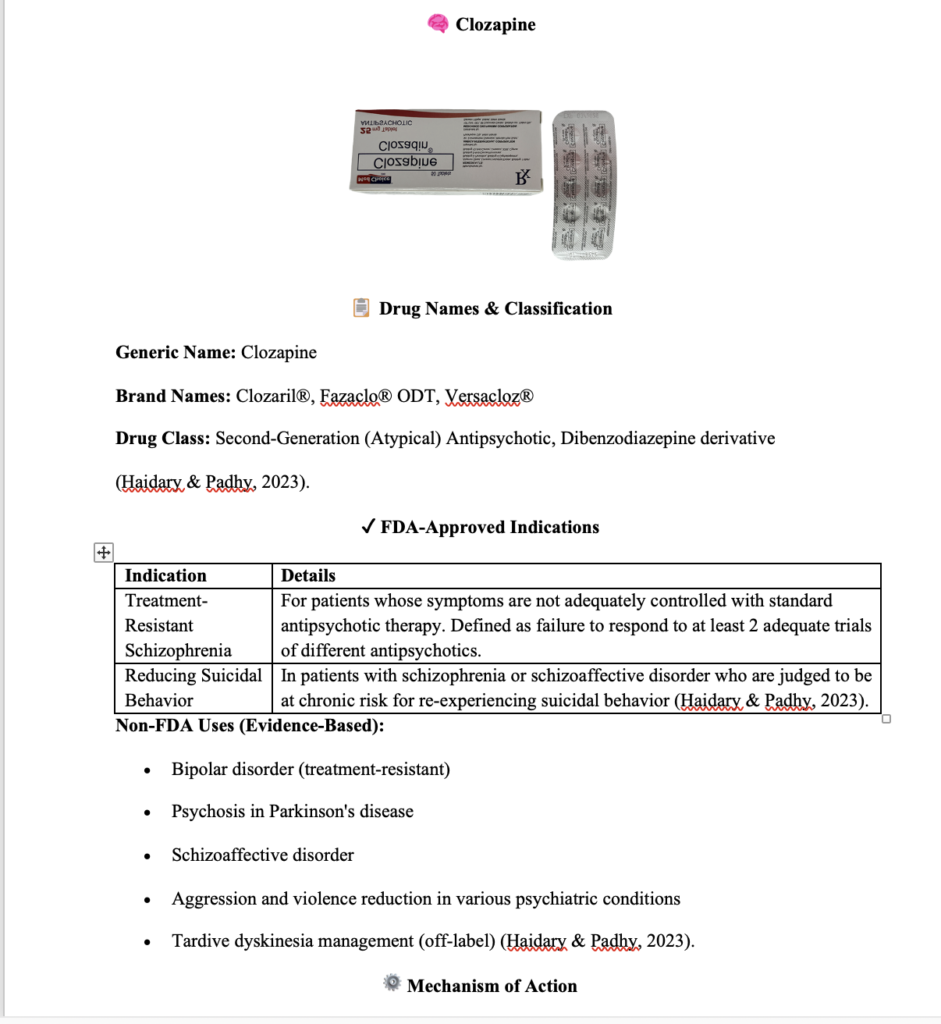
Generic Name: Clozapine
Brand Names: Clozaril®, Fazaclo® ODT, Versacloz®
Drug Class: Second-Generation (Atypical) Antipsychotic, Dibenzodiazepine derivative (Haidary & Padhy, 2023).
✓ FDA-Approved Indications
| Indication | Details |
| Treatment-Resistant Schizophrenia | For patients whose symptoms are not adequately controlled with standard antipsychotic therapy. Defined as failure to respond to at least 2 adequate trials of different antipsychotics. |
| Reducing Suicidal Behavior | In patients with schizophrenia or schizoaffective disorder who are judged to be at chronic risk for re-experiencing suicidal behavior (Haidary & Padhy, 2023). |
Non-FDA Uses (Evidence-Based):
- Bipolar disorder (treatment-resistant)
- Psychosis in Parkinson’s disease
- Schizoaffective disorder
- Aggression and violence reduction in various psychiatric conditions
- Tardive dyskinesia management (off-label) (Haidary & Padhy, 2023).
⚙️ Mechanism of Action
Primary Mechanism: The exact mechanism is not fully understood, but clozapine exhibits:
| Receptor | Action | Clinical Effect |
| D₂ (Dopamine) | Weak antagonism | Antipsychotic effects with LOW EPS risk |
| D₁, D₃, D₄ | Antagonism | Additional antipsychotic activity |
| 5-HT₂ₐ (Serotonin) | Strong antagonism | Improved negative symptoms, reduced EPS |
| 5-HT₁ₐ | Partial agonism | Mood stabilization, anti-anxiety effects |
| α₁-Adrenergic | Antagonism | Orthostatic hypotension (side effect) |
| H₁ (Histamine) | Antagonism | Sedation, weight gain |
| M₁ (Muscarinic) | Weak antagonism | Anticholinergic effects (mild) |
💊 Pharmacokinetics
| Parameter | Value |
| Absorption | Well absorbed orally; bioavailability ~50-60% |
| Time to Peak (Tmax) | 1.1 – 3.6 hours (average 2.5 hours) |
| Protein Binding | ~95% bound to plasma proteins |
| Volume of Distribution | 1.6 – 7.3 L/kg (wide interpatient variability) |
| Metabolism | Extensive hepatic metabolism via CYP1A2 (primary), CYP3A4, CYP2D6, CYP2C19 |
| Half-Life (t½) | Single dose: 8-12 hours Steady state: 12-16 hours (can be up to 29 hours with extended sampling) |
| Excretion | ~50% urine, ~30% feces; <1% excreted unchanged |
| Time to Steady State | 5-7 days |
 Add to Cart to get the full solution
Related:(Completed) NURS 6630 Week 8 Assignment Mood Stabilizer

Reviews
There are no reviews yet.