
Description
NURS 6630 Week 5 Assignment De-Prescribing
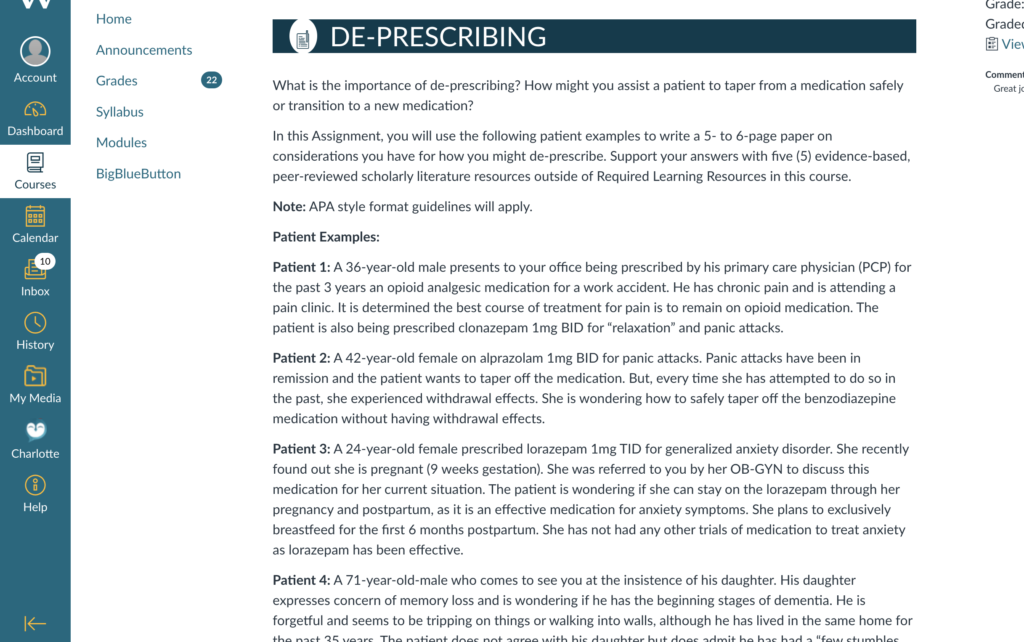
What is the importance of de-prescribing? How might you assist a patient to taper from a medication safely or transition to a new medication?
In this Assignment, you will use the following patient examples to write a 5- to 6-page paper on considerations you have for how you might de-prescribe. Support your answers with five (5) evidence-based, peer-reviewed scholarly literature resources outside of Required Learning Resources in this course.
Note: APA style format guidelines will apply.
Patient Examples:
Patient 1: A 36-year-old male presents to your office being prescribed by his primary care physician (PCP) for the past 3 years an opioid analgesic medication for a work accident. He has chronic pain and is attending a pain clinic. It is determined the best course of treatment for pain is to remain on opioid medication. The patient is also being prescribed clonazepam 1mg BID for “relaxation” and panic attacks.
Patient 2: A 42-year-old female on alprazolam 1mg BID for panic attacks. Panic attacks have been in remission and the patient wants to taper off the medication. But, every time she has attempted to do so in the past, she experienced withdrawal effects. She is wondering how to safely taper off the benzodiazepine medication without having withdrawal effects.
Patient 3: A 24-year-old female prescribed lorazepam 1mg TID for generalized anxiety disorder. She recently found out she is pregnant (9 weeks gestation). She was referred to you by her OB-GYN to discuss this medication for her current situation. The patient is wondering if she can stay on the lorazepam through her pregnancy and postpartum, as it is an effective medication for anxiety symptoms. She plans to exclusively breastfeed for the first 6 months postpartum. She has not had any other trials of medication to treat anxiety as lorazepam has been effective.
Patient 4: A 71-year-old-male who comes to see you at the insistence of his daughter. His daughter expresses concern of memory loss and is wondering if he has the beginning stages of dementia. He is forgetful and seems to be tripping on things or walking into walls, although he has lived in the same home for the past 35 years. The patient does not agree with his daughter but does admit he has had a “few stumbles and falls” lately. Medication reconciliation shows the following medications: metoprolol ER 50mg q day, omeprazole 20mg q day, clonazepam 1mg TID, levothyroxine 75mcg q am. His daughter is wondering if he should be started on a “dementia medication.”
Resources
Be sure to review the Learning Resources before completing this activity.
Click the weekly resources link to access the resources.
To prepare for this Assignment:
- Review the assigned Learning Resources for this week.
- Review the definitions presented in your text and resources for de-prescribing and tapering.
- Consider the importance of de-prescribing.
- Based on the example(s) provided, consider how you might de-prescribe a patient.
The Assignment
Answer the following questions using the patient examples described above.
Patient 1
- What are the concerns of the patient remaining on the opioid medication and clonazepam?
- How might you educate the patient about these risks and concerns?
The patient agrees that he should not continue both medications in combination. He would like to “get off” the clonazepam but worries about “bad withdrawals” that he’s heard about from stopping clonazepam “cold turkey” and is concerned about re-occurring panic attacks. How might you respond to the following:
- How would you instruct the patient to taper off clonazepam?
- What other medication would you recommend for the patient for the treatment of his panic attacks? Keep in mind, he will continue the opioid medication for pain relief.
- How would you start the new recommended psychotropic medication for the patient?
- Discuss one legal, ethical, or social consideration with the treatment plan.
Patient 2
- The patient reports withdrawal symptoms when previously tapering off the alprazolam. What symptoms are common withdrawal symptoms from this medication?
- Provide the patient education of withdrawal symptoms that range from common and less serious to withdrawal symptoms that are a cause for concern and that should prompt patient should seek medical attention.
- Given the patient’s history of having withdrawal effects from attempting to taper off alprazolam, what longer-acting benzodiazepine would you choose to convert the patient to?
- What is the dose you would prescribe and how would you taper off the medication?
Patient 3
- Review the potential risks, benefits, and side effects of continuing lorazepam throughout the pregnancy and postpartum for both the patient and fetus.
- Review other alternative medications to treat generalized anxiety disorder. Include risks, benefits, and potential side effects to both the patient and the developing fetus. Keep in mind, the patient is looking to breast feed for 6 months postpartum.
- The patient agrees that it would be safest for her pregnancy and fetus to discontinue the lorazepam. How would you recommend she discontinue lorazepam? Provide education on potential side effects from tapering off the medication, including common side effects to more serious side effects and when to seek medical attention.
- The patient would like to forgo medications at this time, given she is early in her pregnancy and is concerned about “damage” to the fetus if she were to continue medications. Provide education to the patient about the risks of untreated anxiety symptoms during pregnancy for both the patient and the fetus.
Patient 4
- Review potential side effects for elderly on benzodiazepines providing education to both the patient and the patient’s daughter. What are the risks of continuing the benzodiazepine for this patient?
- How would you evaluate the patient for these side effects?
- The patient and daughter agree he will need to taper off the clonazepam given the risks of continuing this medication. How would you recommend tapering off this medication?
- Review with the patient and daughter potential side effects of tapering off the medication. Review with them common side effects to more serious side effects and when to seek medical attention.
Solution: NURS 6630 Week 5 Assignment De-Prescribing
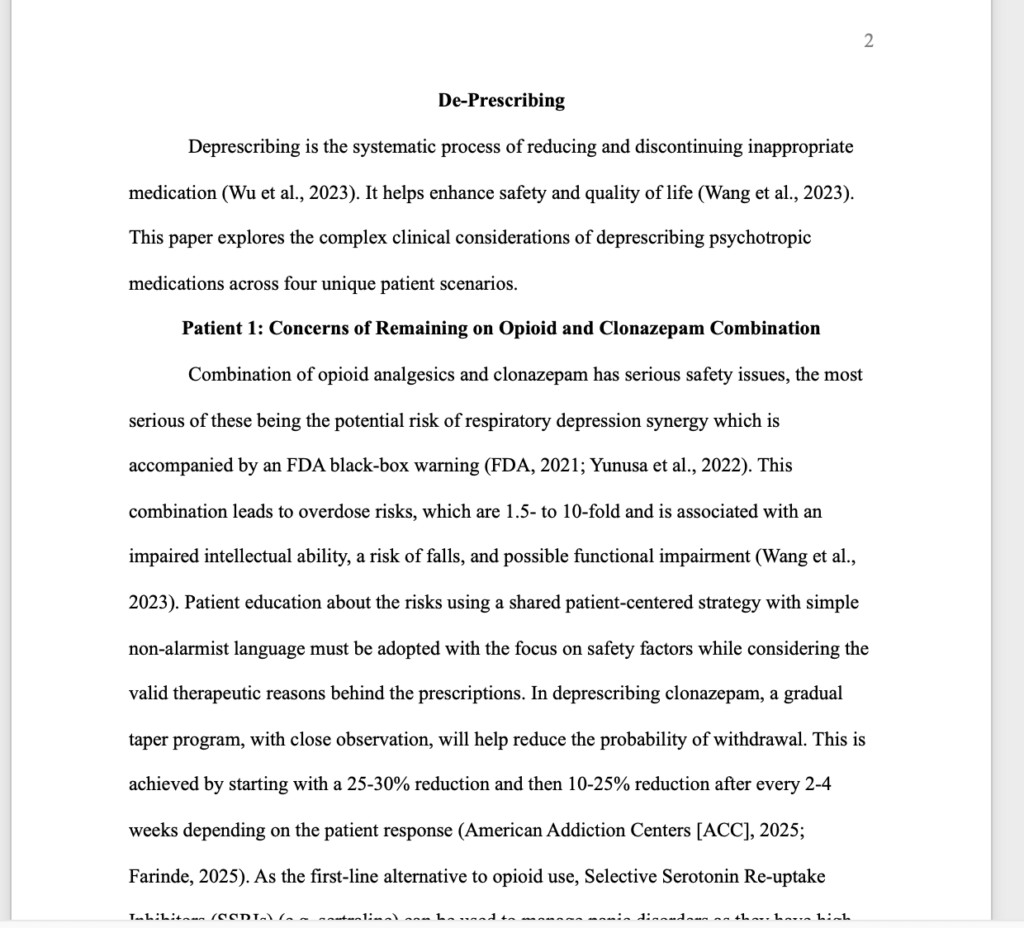
De-Prescribing
Deprescribing is the systematic process of reducing and discontinuing inappropriate medication (Wu et al., 2023). It helps enhance safety and quality of life (Wang et al., 2023). This paper explores the complex clinical considerations of deprescribing psychotropic medications across four unique patient scenarios.
Patient 1: Concerns of Remaining on Opioid and Clonazepam Combination
Combination of opioid analgesics and clonazepam has serious safety issues, the most serious of these being the potential risk of respiratory depression synergy which is accompanied by an FDA black-box warning (FDA, 2021; Yunusa et al., 2022). This combination leads to overdose risks, which are 1.5- to 10-fold and is associated with an impaired intellectual ability, a risk of falls, and possible functional impairment (Wang et al., 2023). Patient education about the risks using a shared patient-centered strategy with simple non-alarmist language must be adopted with the focus on safety factors while considering the valid therapeutic reasons behind the prescriptions. In deprescribing clonazepam, a gradual taper program, with close observation, will help reduce the probability of withdrawal. This is achieved by starting with a 25-30% reduction and then 10-25% reduction after every 2-4 weeks depending on the patient response (American Addiction Centers [ACC], 2025; Farinde, 2025). As the first-line alternative to opioid use, Selective Serotonin Re-uptake Inhibitors (SSRIs) (e.g. sertraline) can be used to manage panic disorders as they have high efficacy and safety profiles and low interaction with opioids (Melaragno, 2021).
Cross-titration is the optimal approach for drug shift, which will involve administration of low dose of SSRI (sertraline 25mg/day) and continuing with clonazepam at the beginning, then slowly increasing the SSRI and gradually reducing the benzodiazepine (BZD) (Yunusa et al., 2022). This process offers a sustained coverage of anxiety with systematic decrease in the exposure to BZDs. Close observation via frequent follow-ups after every 2-4 weeks during this period of transition is essential in evaluating response to treatment and side effects control (Wang et al., 2023). Ethically, beneficence and non-maleficence are crucial as the risk of overdose will decrease, and temporary anxiety increase during taper will be minimized (Yunusa et al., 2022). Legally, there should be extensive records that can prove compliance to standard of care especially with the FDA warning. Socially, deprescribing needs to manage the possible perceptions of patients as treatment abandonment by framing it as therapy optimization using empathetic communication and shared decision-making. This holistic treatment takes care of safety issues and also creates sustainable long-term management of chronic pain and panic disorder (Wu et al., 2023).
Patient 2: Safe Deprescribing of Alprazolam for Panic Disorder in Remission
The short-acting BZD, alprazolam, has a high risk of withdrawal syndrome, especially in long-term use. Rebound anxiety, insomnia, tremors, sweating, palpitations, aggravated sensory perception, restlessness, irritability, nausea, and appetite changes are common withdrawal symptoms (Edinoff et al., 2021). These symptoms typically emerge within hours of a missed dose due to alprazolam’s short half-life (6-12 hours) and peak in intensity within 1-2 days (ACC, 2025; Farinde, 2025). While the symptoms are not life-threatening, they cause discomfort and should be addressed through a slow taper.
Patients education should focus on serious withdrawal symptoms that require urgent
Add to Cart to get full solution
Related: (Completed) NURS 6630 Week 7 Assignment Patient Medication Guide

Reviews
There are no reviews yet.