
Description
NRNP 6635 Week 3 Assignment Assessing and Diagnosing Patients With Mood Disorders
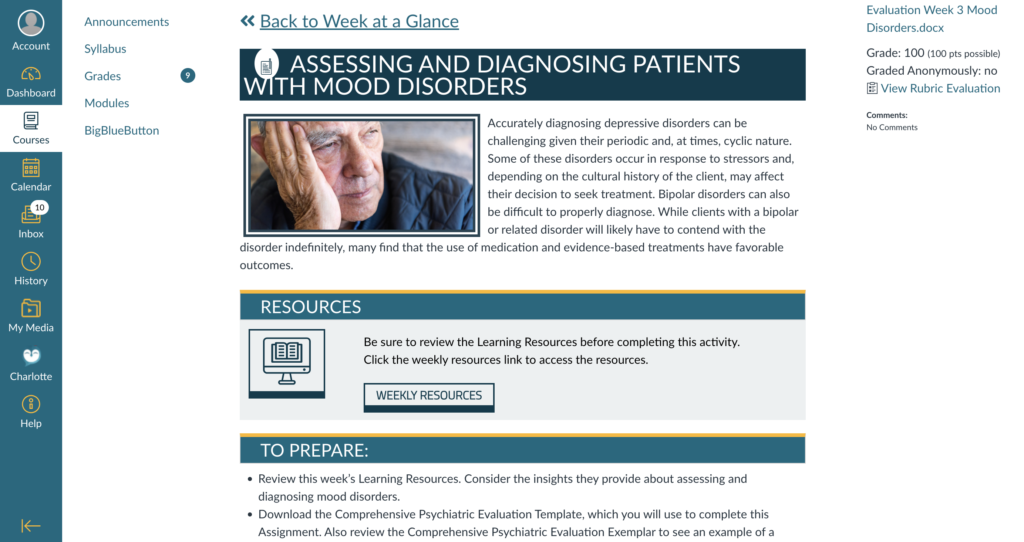
 Accurately diagnosing depressive disorders can be challenging given their periodic and, at times, cyclic nature. Some of these disorders occur in response to stressors and, depending on the cultural history of the client, may affect their decision to seek treatment. Bipolar disorders can also be difficult to properly diagnose. While clients with a bipolar or related disorder will likely have to contend with the disorder indefinitely, many find that the use of medication and evidence-based treatments have favorable outcomes.
Resources
Be sure to review the Learning Resources before completing this activity.
Click the weekly resources link to access the resources.
To Prepare:
- Review this week’s Learning Resources. Consider the insights they provide about assessing and diagnosing mood disorders.
- Download the Comprehensive Psychiatric Evaluation Template, which you will use to complete this Assignment. Also review the Comprehensive Psychiatric Evaluation Exemplar to see an example of a completed evaluation document.
- By Day 1 of this week, select a specific video case study to use for this Assignment from the Video Case Selections choices in the Learning Resources. View your assigned video case and review the additional data for the case in the “Case History Reports” document, keeping the requirements of the evaluation template in mind.
- Consider what history would be necessary to collect from this patient.
- Consider what interview questions you would need to ask this patient.
- Identify at least three possible differential diagnoses for the patient.
By Day 7 of Week 3
Complete and submit your Comprehensive Psychiatric Evaluation, including your differential diagnosis and critical-thinking process to formulate a primary diagnosis. Incorporate the following into your responses in the template:
- Subjective: What details did the patient provide regarding their chief complaint and symptomology to derive your differential diagnosis? What is the duration and severity of their symptoms? How are their symptoms impacting their functioning in life?
- Objective: What observations did you make during the psychiatric assessment?
- Assessment: Discuss the patient’s mental status examination results. What were your differential diagnoses? Provide a minimum of three possible diagnoses with supporting evidence, listed in order from highest priority to lowest priority. Compare the DSM-5-TR diagnostic criteria for each differential diagnosis and explain what DSM-5 criteria rules out the differential diagnosis to find an accurate diagnosis. Explain the critical-thinking process that led you to the primary diagnosis you selected. Include pertinent positives and pertinent negatives for the specific patient case.
- Reflection notes: What would you do differently with this client if you could conduct the session over? Also include in your reflection a discussion related to legal/ethical considerations (demonstrate critical thinking beyond confidentiality and consent for treatment!), health promotion and disease prevention taking into consideration patient factors (such as age, ethnic group, etc.), PMH, and other risk factors (e.g., socioeconomic, cultural background, etc.).
Solution: NRNP 6635 Week 3 Assignment Assessing and Diagnosing Patients With Mood Disorders
Week 3 Mood Disorders
This paper discusses the psychiatric evaluation of a female patient presenting with severe cyclical physical and emotional symptoms significantly impacting her occupational and social functioning. The patient reports debilitating premenstrual symptoms including intense pain, mood lability, irritability, depressed mood, anxiety, concentration difficulties, and binge eating episodes that have occurred since menarche and worsened after childbirth. These symptoms follow a predictable pattern, beginning one week before menses and resolving shortly after flow onset, with complete remission during the follicular phase.
Subjective:
CC (chief complaint): “Everything just… It feels so overwhelming” (Symptom Media, 2018).
HPI: A.H. is a 26 years old female patient presenting for psychiatric evaluation of severe menstrual-related symptoms. She is not currently prescribed psychiatric medications. The patient reports cyclical symptoms beginning approximately one week before menses including intense cramping, severe breast tenderness, bloating, dizziness, headaches, back pain, marked mood lability, irritability with urges to break things, depressed mood with tearfulness, anxiety, severe fatigue, and difficulty concentrating. She experiences binge eating episodes with loss of impulse control during symptomatic periods. Symptoms resolve within 1-2 days after menstrual flow begins, with complete remission for 2-3 weeks monthly when she functions as “one of the best workers in the office.” Symptoms began at menarche (age 10-11) and worsened significantly after childbirth. Functional impairment is severe as she has lost two paralegal jobs, requires neighbor assistance for school transportation, and depends on ex-husband for childcare during episodes. She denies suicidal ideation, hallucinations, and substance use. She manages symptoms with ibuprofen and journaling, with minimal benefit from over-the-counter supplements.
Past Psychiatric History:
- General Statement: Patient saw a therapist for several years following divorce but was never diagnosed with a major psychiatric disorder.
- Caregivers (if applicable): NA
- Hospitalizations: None reported.
- Medication trials: None.
- Psychotherapy or Previous Psychiatric Diagnosis: Attended therapy post-divorce for several years to address anxiety and adjustment issues related to relationship ending. No formal diagnosis of clinical depression was made. Learned coping mechanisms and discontinued therapy when symptoms resolved.
Substance Current Use and History: High caffeine consumption (described as “nonstop”). Denies alcohol, tobacco, or illicit drug use.
Family Psychiatric/Substance Use History: Depression on maternal side. Maternal uncle completed suicide. No other psychiatric or substance use history reported.
Psychosocial History: She was born and raised in Mesa, Arizona, and currently resides in Scottsdale, Arizona. She is divorced and the single mother of two children: an eight-year-old daughter and a four-year-old son. She has an Associate’s degree and works as a paralegal in a demanding legal environment, a role she values but which has been jeopardized by her cyclical symptoms. She reports no legal history. Her support system is limited; she relies intermittently on a neighbor for childcare and transportation during symptomatic periods and maintains a strained but functional co-parenting relationship with her ex-husband solely concerning the children. She has a history of rosacea. She describes her daily life as highly stressful, balancing full-time work with single parenthood, and notes that her premenstrual symptoms severely disrupt her ability to maintain this routine, contributing to significant occupational and parental strain..
Medical History:
- Current Medications: Ibuprofen as needed for menstrual cramping.
- Allergies: Dicyclomine
- Reproductive Hx: Menarche at age 10-11. Reports severe menstrual-related symptoms since first period. Regular monthly cycles. Symptoms begin approximately one week before menses and resolve within 1-2 days of flow onset. Not currently using hormonal contraception.
ROS:
- GENERAL: Reports fatigue and energy depletion during luteal phase; weight fluctuations related to fluid retention; denies fever, chills, or unintentional weight loss.
- HEENT: Reports headaches during symptomatic periods; denies vision changes, hearing loss, tinnitus, sore throat, or nasal congestion.
- SKIN: Denies rashes, lesions, or changes in skin integrity.
- CARDIOVASCULAR: Denies chest pain, palpitations, orthopnea, or peripheral edema outside of cyclical fluid retention.
- RESPIRATORY: Denies shortness of breath, cough, wheezing, or dyspnea.
- GASTROINTESTINAL: Reports bloating and fluid retention cyclically; increased appetite and food cravings during symptomatic periods; otherwise denies nausea, vomiting, diarrhea, constipation, abdominal pain, or changes in bowel habits.
- GENITOURINARY: Reports severe menstrual cramps (dysmenorrhea); denies dysuria, hematuria, urinary frequency, or incontinence.
- NEUROLOGICAL: Reports dizziness during symptomatic periods; denies syncope, seizures, tremors, weakness, numbness, tingling, or hallucinations (explicitly denied when questioned).
- MUSCULOSKELETAL: Reports severe lower back pain during menses; denies joint pain, swelling, or limitation of movement otherwise.
- HEMATOLOGIC: Denies easy bruising, bleeding, or history of anemia.
- LYMPHATICS: Denies lymphadenopathy or swelling.
- ENDOCRINOLOGIC: Reports breast tenderness cyclically; denies heat/cold intolerance, excessive thirst, polyuria, or other endocrine symptoms.
Add to cart to get full solution

Reviews
There are no reviews yet.