Description
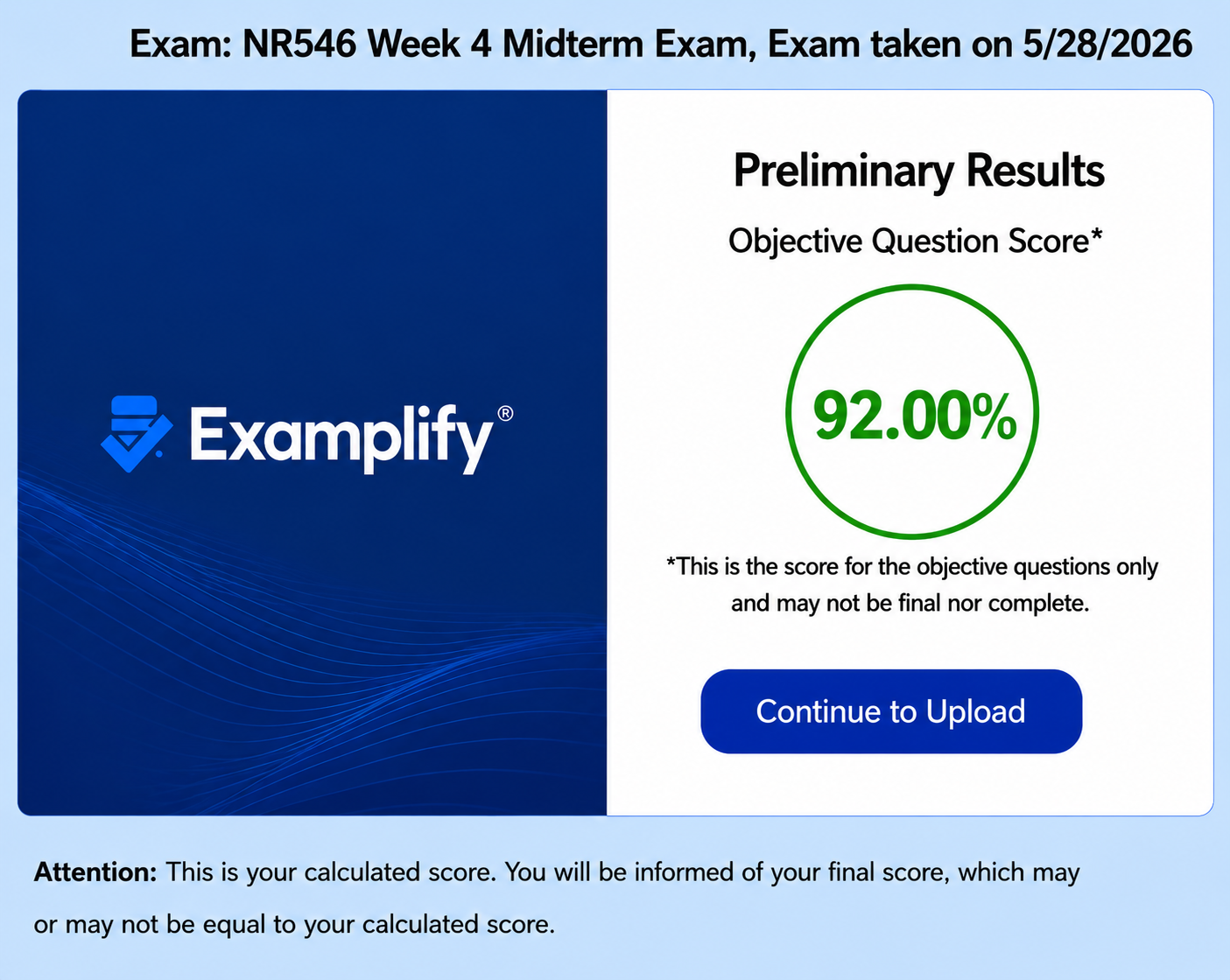
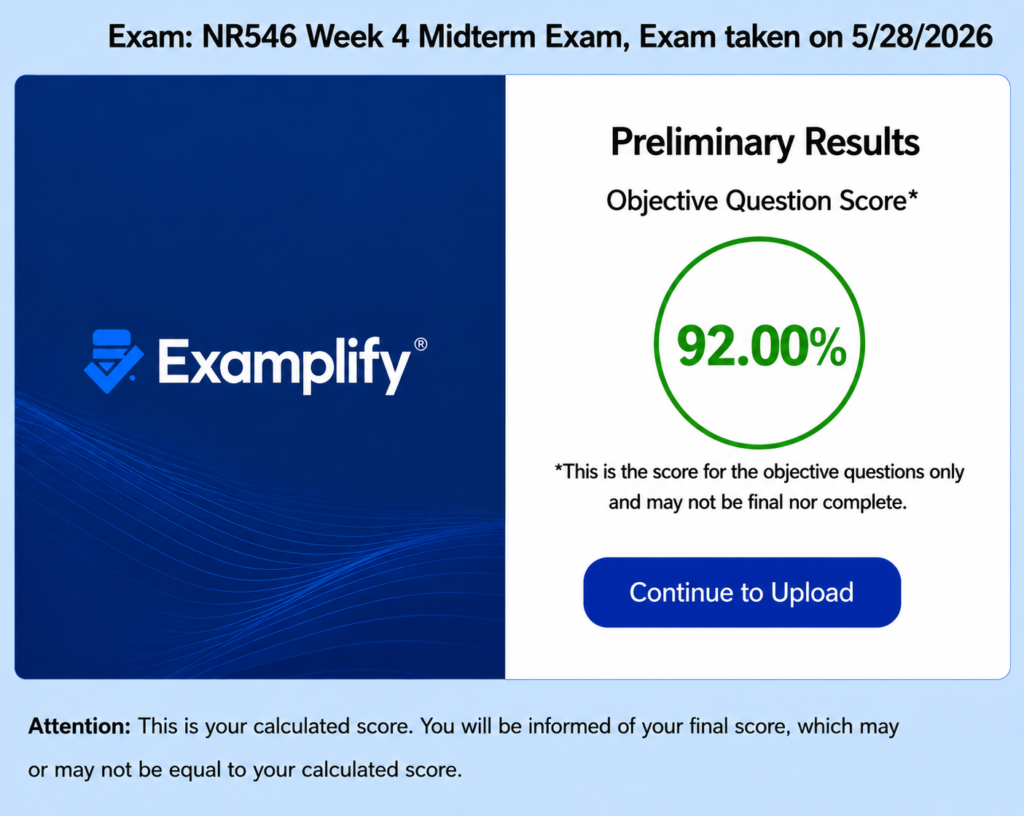
NR546 Week 4 Midterm Exam
The PMHNP is consulting for a client with schizophrenia who has been hospitalized with cellulitis. His family reports that he takes an antipsychotic medication, but they are unsure which medication. His CBC results reveal agranulocytosis. Which antipsychotic medication is the client most likely taking?
Answers: A – D
- olanzapine
B. ziprasidone
C. clozapine ✅
D. haloperidol
The psychiatric mental health nurse practitioner educates a client about a newly prescribed SSRI. The client asks why it will take so long for the medication to start working effectively. The delay in drug efficacy is related to which system?
Answers: A – D
- agonist spectrum
B. cytochrome P450 enzyme system
C. signal transduction cascade ✅
D. hormone linked system
Which situation presents an ethical challenge for the psychiatric mental health nurse practitioner?
Answers: A – D
- The client is a physician.
B. The client provides informed consent for treatment.
C. The client’s mother pays for the client’s therapy.
D. The client has impaired cognitive status. ✅
Smoking induces the CYP1A2 enzyme. As the prescriber, how does this affect your prescribing decisions?
Answers: A – C
- There is no impact on dosing requirements for smokers or nonsmokers.
B. Cigarette smokers may require higher doses of 1A2 substrates than nonsmokers. ✅
C. Cigarette smokers may require lower doses of 1A2 substrates than nonsmokers.
The psychiatric mental health nurse practitioner (PMHNP) is caring for a client with symptoms of depression. Which type of medication should the PMHNP prescribe to increase serotonin levels?
Answers: A – D
- partial agonist
B. antagonist
C. agonist ✅
D. inverse agonist
A client with schizophrenia reports auditory hallucinations and is responding to internal stimuli. Which medication is appropriate to initiate for first line treatment of this newly diagnosed client?
Answers: A – D
- haloperidol
B. clozapine
C. lurasidone ✅
D. fluphenazine
In which situation would it be most appropriate to prescribe a benzodiazepine as a first-line treatment?
Answers: A – D
- a client who presents to the emergency department with acute anxiety symptoms ✅
B. a client with social anxiety with a history of substance use disorder
C. a client who presents to the PMHNP clinic with symptoms of generalized anxiety
D. a client with obsessive-compulsive disorder
A client is receiving a trial of clozapine. The PMHNP must monitor for which medication related complication?
Answers: A – D
- low energy
B. thyroid function
C. auditory hallucinations
D. agranulocytosis ✅
Which of the following are the six neurotransmitters that are targeted by psychotropic drugs?
Answers: A – D
- serotonin, dopamine, histamine, cannabinoids, norepinephrine, gamma aminobutyric acid
B. endorphins, cannabinoids, thyroxin, glutamate, acetylcholine, serotonin
C. GABA, endorphins, thyroxin, dopamine, epinephrine, serotonin
D. serotonin, norepinephrine, dopamine, acetylcholine, glutamate, gamma aminobutyric acid ✅
A client presenting to the ED with acute psychotic symptom received a stat dose of medication. Upon admission to the psychiatric unit, the client exhibits acute dystonia. Which medication was most likely administered in the ED?
Answers: A – D
- quetiapine
B. risperidone
C. clozapine
D. haloperidol ✅
Which neurotransmitter has been implicated in the overactivity of the mesolimbic DA pathway in schizophrenia?
Answers: A – D
- serotonin
B. norepinephrine
C. GABA
D. glutamate ✅
Which of the following medications is associated with an increased risk of suicide in clients under the age of 30?
Answers: A – D
- hydroxyzine
B. pregabalin
C. lorazepam
D. sertraline ✅
The PMHNP has diagnosed a client with depression. Which two neurotransmitters should be considered when selecting a medication to target mood?
Answers: A – D
- serotonin and norepinephrine ✅
B. norepinephrine and histamine
C. GABA and dopamine
D. serotonin and thyroxin
Which atypical antipsychotic has the greatest efficacy but the most serious side effect profile?
Answers: A – D
- olanzapine
B. risperidone
C. lurasidone
D. clozapine ✅
The psychiatric mental health nurse practitioner (PMHNP) is treating a pregnant woman for depression. Which does the PMHNP consider when selecting a medication?
Answers: A – D
- all psychotropic medications are safe to use during pregnancy
B. the potential maternal side effects, which are different during pregnancy
C. the potential risks and benefits of medication for mother and fetus ✅
D. all psychotropic medications are contraindicated during pregnancy
Client education regarding benzodiazepines should include which of the following?
Answers: A – D
- Clients should not take benzodiazepines concurrently with a selective serotonin reuptake inhibitor.
B. Clients should not take benzodiazepines on an empty stomach.
C. Clients should not drive after taking a benzodiazepine. ✅
D. Clients should not take any benzodiazepines while breastfeeding.
The psychiatric mental health nurse practitioner prescribes a client haloperidol, a dopamine antagonist, to treat schizophrenia. What is the action of haloperidol after binding to the dopamine receptors?
Answers: A – D
- causes the opposite effect as an agonist ✅
B. does not fully activate a biological response
C. does not activate a biological response
D. activates a full biological response
When comparing conventional and atypical antipsychotic medication, which statement is most accurate?
Answers: A – D
- Conventional and atypical antipsychotics are very similar in therapeutic profile but differ in side-effect profile. ✅
B. Conventional antipsychotics differ from atypical antipsychotics in therapeutic profile but are similar in side-effect profile.
C. Conventional and atypical antipsychotics are very similar in both therapeutic and side-effect profile.
D. Conventional antipsychotics significantly differ from atypical antipsychotics in both therapeutic and side-effect profile.
The psychiatric mental health nurse practitioner (PMHNP) is performing a mental status exam and the client has difficulty identifying a pencil. The PMHNP associates this deficit with which part of the brain?
Answers: A – D
- temporal lobe
B. parietal lobe ✅
C. occipital lobe
D. frontal lobe
Which initial antidepressant regimen is likely to be the best tolerated by a client with social anxiety disorder?
Answers: A – D
- venlafaxine XR 75 mg daily
B. sertraline 50 mg daily ✅
C. bupropion XL 300 mg daily
D. duloxetine 60 mg daily
Which factor is most responsible for the increased incidence of mental health illness?
Answers: A – D
- increasing number of older adults
B. evolving genetics
C. environmental factors
D. improved screening for mental illness ✅
In which situation can the psychiatric mental health nurse practitioner forcibly medicate a client?
Answers: A – D
- The client has psychotic symptoms and declines treatment.
B. The client is incompetent to provide informed consent.
C. The client is violent and other methods have been unsuccessful. ✅
D. The client is a harm to themself.
The psychiatric mental health nurse practitioner (PMHNP) interviews a client who reports having anxiety, thoughts of harming self, and difficulty focusing attention. Which area of the brain is associated with the client’s symptoms?
Answers: A – D
- white matter
B. temporal lobes
C. prefrontal cortex ✅
D. occipital lobe
An inverse agonist functions in which of the following ways?
Answers: A – D
- An inverse agonist decreases transduction.
B. An inverse agonist has no effect on transduction.
C. An inverse agonist has the opposite effect of the agonist on transduction. ✅
D. An inverse agonist increases transduction.

Reviews
There are no reviews yet.