
Description
NRNP 6635 Week 10 Assignment Neurocognitive and Neurodevelopmental Disorders
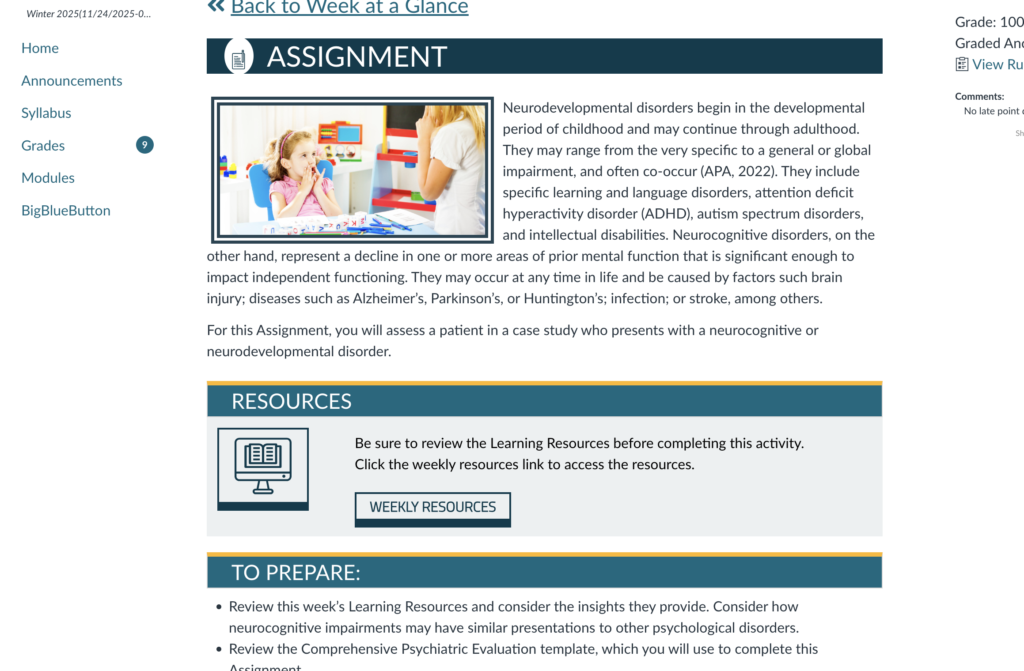
Neurodevelopmental disorders begin in the developmental period of childhood and may continue through adulthood. They may range from the very specific to a general or global impairment, and often co-occur (APA, 2022). They include specific learning and language disorders, attention deficit hyperactivity disorder (ADHD), autism spectrum disorders, and intellectual disabilities. Neurocognitive disorders, on the other hand, represent a decline in one or more areas of prior mental function that is significant enough to impact independent functioning. They may occur at any time in life and be caused by factors such brain injury; diseases such as Alzheimer’s, Parkinson’s, or Huntington’s; infection; or stroke, among others.
For this Assignment, you will assess a patient in a case study who presents with a neurocognitive or neurodevelopmental disorder.
Resources
Be sure to review the Learning Resources before completing this activity.
Click the weekly resources link to access the resources.
To Prepare:
- Review this week’s Learning Resources and consider the insights they provide. Consider how neurocognitive impairments may have similar presentations to other psychological disorders.
- Review the Comprehensive Psychiatric Evaluation template, which you will use to complete this Assignment.
- By Day 1 of this week, select a specific video case study to use for this Assignment from the Video Case Selections choices in the Learning Resources. View your assigned video case and review the additional data for the case in the “Case History Reports” document, keeping the requirements of the evaluation template in mind.
- Consider what history would be necessary to collect from this patient.
- Consider what interview questions you would need to ask this patient.
- Identify at least three possible differential diagnoses for the patient.
By Day 7 of Week 10
Complete and submit your Comprehensive Psychiatric Evaluation, including your differential diagnosis and critical-thinking process to formulate primary diagnosis.
Incorporate the following into your responses in the template:
- Subjective: What details did the patient provide regarding their chief complaint and symptomology to derive your differential diagnosis? What is the duration and severity of their symptoms? How are their symptoms impacting their functioning in life?
- Objective: What observations did you make during the psychiatric assessment?
- Assessment: Discuss the patient’s mental status examination results. What were your differential diagnoses? Provide a minimum of three possible diagnoses with supporting evidence, listed in order from highest priority to lowest priority. Compare the DSM-5-TR diagnostic criteria for each differential diagnosis and explain what DSM-5-TR criteria rules out the differential diagnosis to find an accurate diagnosis. Explain the critical-thinking process that led you to the primary diagnosis you selected. Include pertinent positives and pertinent negatives for the specific patient case.
- Reflection notes: What would you do differently with this client if you could conduct the session over? Also include in your reflection a discussion related to legal/ethical considerations (demonstrate critical thinking beyond confidentiality and consent for treatment!), health promotion and disease prevention taking into consideration patient factors (such as age, ethnic group, etc.), PMH, and other risk factors (e.g., socioeconomic, cultural background, etc.).
Solution: NRNP 6635 Week 10 Assignment Neurocognitive and Neurodevelopmental Disorders
This SOAP note evaluates eleven-year-old Sarah Higgins who presents with chronic symptoms of inattention and hyperactivity persisting since kindergarten. By synthesizing historical data from her mother and teachers with clinical observations, this assessment aims to establish a diagnosis and reflect on various aspects.
Subjective:
CC (chief complaint): “She has trouble paying attention and remembering things” (Symptom Media, 2017).
HPI: SH is an 11-year-old female who presents for a psychiatric evaluation regarding attention and hyperactivity concerns. She is not currently prescribed any psychotropic medications. She was referred for this evaluation after her mother and teachers completed ADHD screening questionnaires. The patient and her mother report significant difficulties with attention and memory that have persisted since she started kindergarten. SH struggles to remember verbal assignments and often loses the physical lists her teachers provide for her. Her mother notes that this forgetfulness occurs nearly every day. SH frequently misplaces items such as school books and personal belongings like a cherished bracelet. In terms of hyperactivity and impulsivity, SH reports that she has difficulty sitting still in her chair at school and engages in frequent fidgeting. While she can focus on video games or books she enjoys for short bursts, her mother observes that she typically runs between activities rather than engaging calmly. Historically, she displayed significant impulsive behaviors such as jumping into pools before learning to swim or reaching into animal cages at the zoo. During the psychiatric review of symptoms, SH admits to frequent daydreaming during class which often involves thoughts about her dog or missing her mother. She experiences frustration and occasionally loses her temper when she realizes she has missed instructions or made numerous mistakes on her schoolwork despite trying to do it correctly. Her mother reports that while she is polite in one-on-one settings, she has more difficulty waiting her turn and following social cues in group environments. These symptoms are currently impacting her academic performance and her ability to function effectively in group settings.
Past Psychiatric History:
- General Statement: The patient has no prior history of psychiatric treatment or mental health interventions.
- Caregivers (if applicable): Sarah lives with her mother in Washington, D.C. The parents are currently separated, and the mother reports they are working toward reconciliation. Sarah has one younger brother who also resides in the home.
- Hospitalizations: No prior psychiatric hospitalizations.
- Medication trials: No previous psychotropic medication trials.
- Psychotherapy or Previous Psychiatric Diagnosis: No prior psychotherapy or formal psychiatric diagnoses.
Substance Current Use and History: Not applicable given patient’s age of 11 years old. No reported substance use.
Family Psychiatric/Substance Use History: No family psychiatric history or substance use history documented in the available case information.
Psychosocial History: Sarah is an 11 year old female currently enrolled in school. She lives with her mother and younger brother in Washington, D.C. Her parents are currently separated but working toward reunification. The patient misses her mother during the separation, which she reports thinking about during daydreaming episodes at school. Sarah enjoys art and visiting museums, though her mother notes she runs from painting to painting rather than viewing them for extended periods. She has a pet dog named Conley whom she enjoys playing with at home. Sarah experienced a peer conflict at school when another student named May Ann hit her on one occasion, but this does not appear to be an ongoing concern. She demonstrates appropriate social manners and politeness in structured settings. The patient has adequate social support from her grandmother, who she calls Mimi, who provides her with gifts such as the bracelet Sarah recently lost.
Medical History:
- Current Medications: The patient is not currently taking any medications.
- Allergies: NKDA
- Reproductive Hx: Not applicable given the patient’s prepubescent age of 11 years old.
ROS:
- GENERAL: There is no report of fever chills or fatigue and her weight is stable at sixty five pounds. She sleeps approximately nine to ten hours each night.
- HEENT: Sarah denies any blurred vision or double vision. There is no history of hearing loss or congestion.
- SKIN: No rashes or itching are noted or reported by the patient or her mother.
- CARDIOVASCULAR: Her heart rate is fifty eight beats per minute and her blood pressure is ninety eight over sixty two. She denies chest pain or palpitations.
- RESPIRATORY: Her respiratory rate is fourteen breaths per minute. There is no report of cough or shortness of breath.

Reviews
There are no reviews yet.