
Description
(Completed) NRNP-6645 Week 10 Assignment Therapy for Clients With Personality Disorders

Therapy for Clients With Personality Disorders

Individuals with personality disorders often find it difficult to overcome the enduring patterns of thought and behavior that they have thus far experienced and functioned with in daily life. Even when patients are aware that personality-related issues are causing significant distress and functional impairment and are open to counseling, treatment can be challenging for both the patient and the therapist. For this Assignment, you examine specific personality disorders and consider therapeutic approaches you might use with clients.
Resources
Be sure to review the Learning Resources before completing this activity.
Click the weekly resources link to access the resources.
To prepare:
- Review this week’s Learning Resources and reflect on the insights they provide about treating clients with personality disorders.
- Select one of the personality disorders from the DSM-5-TR (e.g., paranoid, antisocial, narcissistic). Then, select a therapy modality (individual, family, or group) that you might use to treat a client with the disorder you selected.
The Assignment:
Succinctly, in 1–2 pages, address the following:
- Briefly describe the personality disorder you selected, including the DSM-5-TR diagnostic criteria.
- Explain a therapeutic approach and a modality you might use to treat a client presenting with this disorder. Explain why you selected the approach and modality, justifying their appropriateness.
- Next, briefly explain what a therapeutic relationship is in psychiatry. Explain how you would share your diagnosis of this disorder with the client in order to avoid damaging the therapeutic relationship. Compare the differences in how you would share your diagnosis with an individual, a family, and in a group session.
Support your response with specific examples from this week’s Learning Resources and at least three peer-reviewed, evidence-based sources. Explain why each of your supporting sources is considered scholarly. Attach the PDFs of your sources.
Solution: NRNP-6645 Week 10 Assignment Therapy for Clients With Personality Disorders
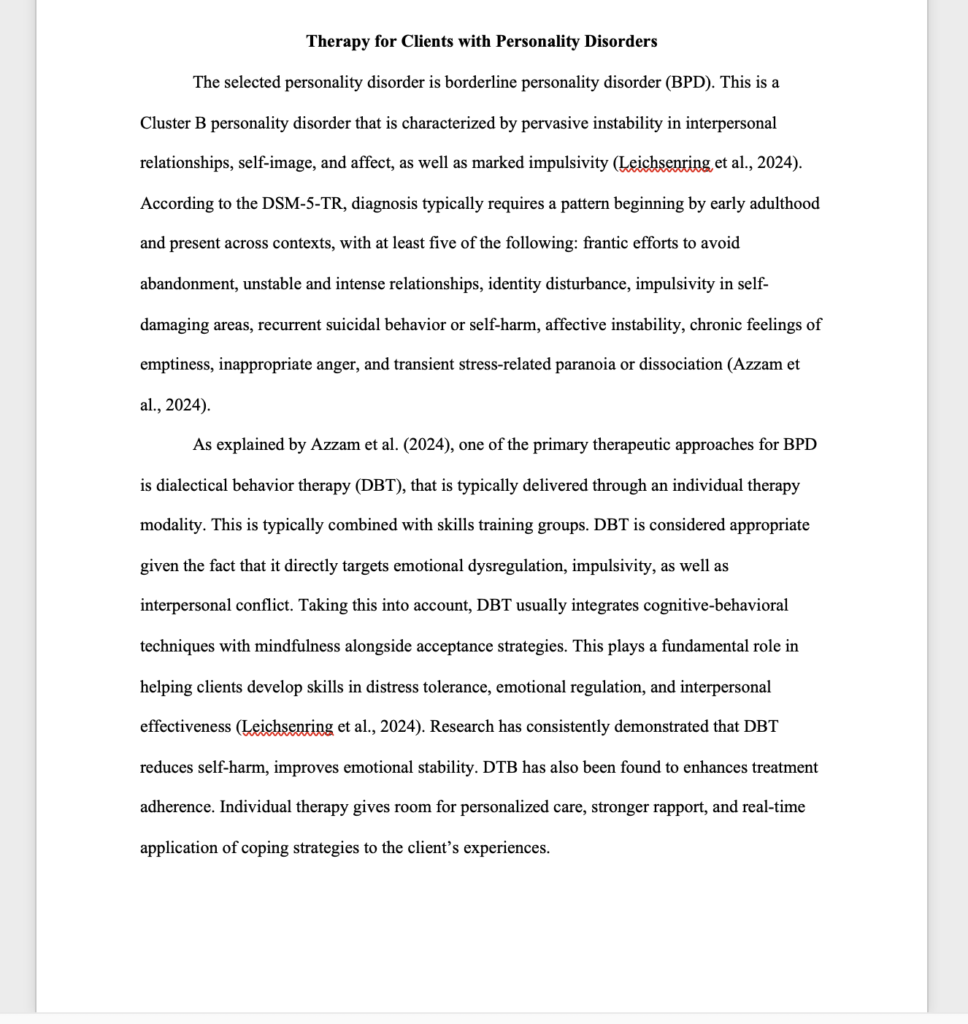
Therapy for Clients with Personality Disorders
The selected personality disorder is borderline personality disorder (BPD). This is a Cluster B personality disorder that is characterized by pervasive instability in interpersonal relationships, self-image, and affect, as well as marked impulsivity (Leichsenring et al., 2024). According to the DSM-5-TR, diagnosis typically requires a pattern beginning by early adulthood and present across contexts, with at least five of the following: frantic efforts to avoid abandonment, unstable and intense relationships, identity disturbance, impulsivity in self-damaging areas, recurrent suicidal behavior or self-harm, affective instability, chronic feelings of emptiness, inappropriate anger, and transient stress-related paranoia or dissociation (Azzam et al., 2024).
As explained by Azzam et al. (2024), one of the primary therapeutic approaches for BPD is dialectical behavior therapy (DBT), that is typically delivered through an individual therapy modality. This is typically combined with skills training groups. DBT is considered appropriate given the fact that it directly targets emotional dysregulation, impulsivity, as well as interpersonal conflict. Taking this into account, DBT usually integrates cognitive-behavioral techniques with mindfulness alongside acceptance strategies. This plays a fundamental role in
Add to Cart to get full solution
Related:(Completed) NRNP-6645 Week 9 Assignment Posttraumatic Stress Disorder

Reviews
There are no reviews yet.