
Description
NURS 6630 Week 10 Assignment Special Considerations for Patient Populations Paper
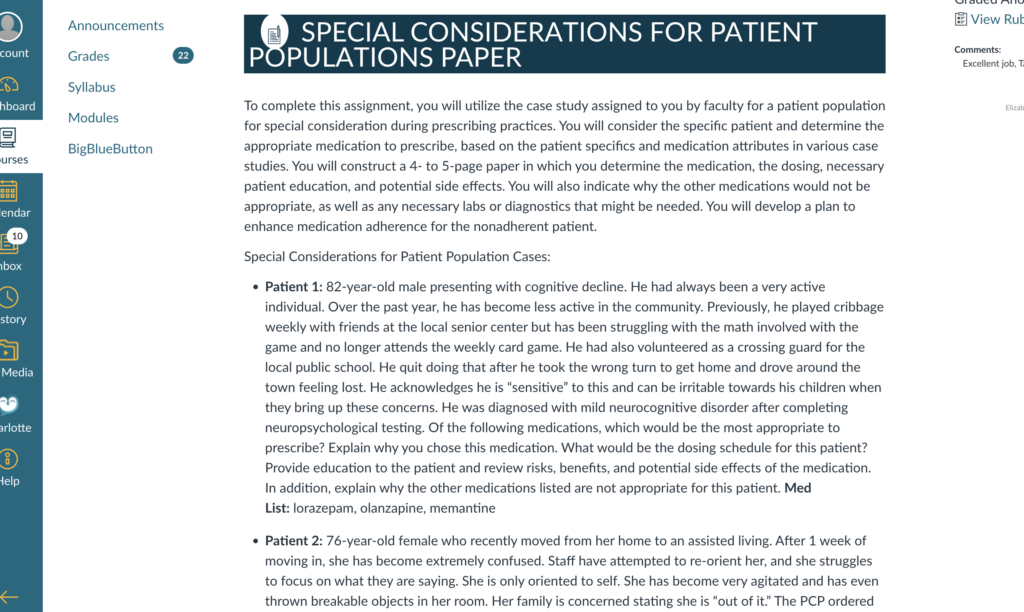
To complete this assignment, you will utilize the case study assigned to you by faculty for a patient population for special consideration during prescribing practices. You will consider the specific patient and determine the appropriate medication to prescribe, based on the patient specifics and medication attributes in various case studies. You will construct a 4- to 5-page paper in which you determine the medication, the dosing, necessary patient education, and potential side effects. You will also indicate why the other medications would not be appropriate, as well as any necessary labs or diagnostics that might be needed. You will develop a plan to enhance medication adherence for the nonadherent patient.
Special Considerations for Patient Population Cases:
- Patient 1: 82-year-old male presenting with cognitive decline. He had always been a very active individual. Over the past year, he has become less active in the community. Previously, he played cribbage weekly with friends at the local senior center but has been struggling with the math involved with the game and no longer attends the weekly card game. He had also volunteered as a crossing guard for the local public school. He quit doing that after he took the wrong turn to get home and drove around the town feeling lost. He acknowledges he is “sensitive” to this and can be irritable towards his children when they bring up these concerns. He was diagnosed with mild neurocognitive disorder after completing neuropsychological testing. Of the following medications, which would be the most appropriate to prescribe? Explain why you chose this medication. What would be the dosing schedule for this patient? Provide education to the patient and review risks, benefits, and potential side effects of the medication. In addition, explain why the other medications listed are not appropriate for this patient. Med List: lorazepam, olanzapine, memantine
- Patient 2: 76-year-old female who recently moved from her home to an assisted living. After 1 week of moving in, she has become extremely confused. Staff have attempted to re-orient her, and she struggles to focus on what they are saying. She is only oriented to self. She has become very agitated and has even thrown breakable objects in her room. Her family is concerned stating she is “out of it.” The PCP ordered labs and UA. Labs are unremarkable outside of mild leukocytosis and positive dipstick analysis for nitrite and red blood cells. Med List: valproate, alprazolam, trimethoprim
- Patient 3: A 33-year-old female that is 6 weeks postpartum. She presents with depressed mood, sadness, easily emotional, difficulties with sleep even when the infant is sleeping. She has lost weight and has a poor appetite. You note psychomotor retardation. She has limited interests in hobbies or bonding with the infant. Her partner is concerned and reports she is typically active and “bubbly” and enjoys the outdoors. She is diagnosed with major depressive disorder, with postpartum onset. She denies suicidal ideation, homicidal ideation, or infanticidal ideation. No psychotic symptoms are present. She is nursing the infant and wants to continue this hoping it will assist with bonding with the infant. Med List: lithium, paroxetine, sertraline
- Patient 4: 10-year-old male who comes in with his father. He has been diagnosed with generalized anxiety disorder. He has constant worries that he cannot control. He feels nervous and tense. He is easily irritable. He struggles to settle down or relax. He is also quite fidgety and restless. He and his father are interested in medications to manage these symptoms. Med List: quetiapine, duloxetine, fluoxetine
- Patient 5: 27-year-old male with a diagnosis of schizophrenia. He has been hospitalized three (3) times in the past 1 year due to symptoms. When symptomatic, he becomes disorganized and paranoid. He will respond to auditory hallucinations. He will scream out at night after seeing a shadow in his room. He has delusions that the CIA is poisoning food and will not eat for multiple days. He has unintentionally hurt his mother after “slapping” food out of her hand, as he did not want her to ingest the “poisoned food.” Symptoms are treated very well with paliperidone, but he struggles to remember to take it. Med List: paliperidone palmitate, clozapine, lamotrigine
Resources
Be sure to review the Learning Resources before completing this activity.
Click the weekly resources link to access the resources.
To Prepare:
- Review the Learning Resources.
- Carefully review your assigned vulnerable population patient.
- Carefully review the medication list to determine the best medication to prescribe.
- Consider the implications, impact, advantages, and disadvantages of the listed medications.
The Assignment (4–5 pages)
Construct a paper concerning your assigned vulnerable population patient case. In your paper include the following:
- Determine which medication would be most appropriate to prescribe from the assigned vulnerable population patient case medication choices.
- Explain your rationale for choosing this medication. Explain why the other medications listed are not appropriate for this patient.
- Explain the dosing schedule for the specific patient including the therapeutic endpoint.
- Provide necessary education to the patient to review risks, benefits, and potential side effects of the medication.
- Describe any necessary labs or additional diagnostics needed prior to prescribing this medication.
- Explain how you might monitor efficacy or side effects of the medication.
- Include any additional collaboration or education to others that would be necessary for this patient. Consider family members, home health care, primary care providers, etc.
- What would you need to include in your assessment for a patient who may become nonadherent with your prescribing plan for your scenario? What are alternative treatment solutions based upon how you assessed? Describe your new treatment plan.
This Assignment requires a minimum of five (5) peer-reviewed, evidence-based scholarly references outside of course resources.
Note: You will need to include the APA style formatting.
Solution: NURS 6630 Week 10 Assignment Special Considerations for Patient Populations Paper
Special Considerations for Patient Populations
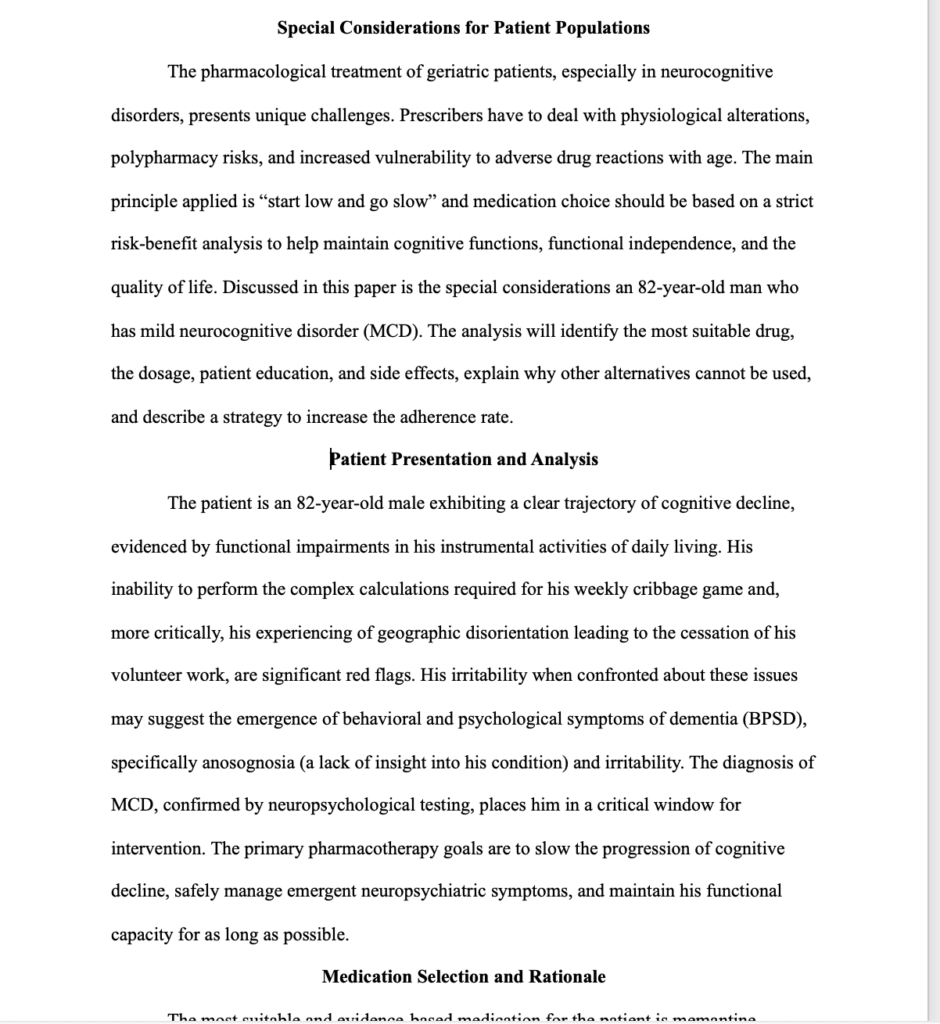
The pharmacological treatment of geriatric patients, especially in neurocognitive disorders, presents unique challenges. Prescribers have to deal with physiological alterations, polypharmacy risks, and increased vulnerability to adverse drug reactions with age. The main principle applied is “start low and go slow” and medication choice should be based on a strict risk-benefit analysis to help maintain cognitive functions, functional independence, and the quality of life. Discussed in this paper is the special considerations an 82-year-old man who has mild neurocognitive disorder (MCD). The analysis will identify the most suitable drug, the dosage, patient education, and side effects, explain why other alternatives cannot be used, and describe a strategy to increase the adherence rate.
Patient Presentation and Analysis
The patient is an 82-year-old male exhibiting a clear trajectory of cognitive decline, evidenced by functional impairments in his instrumental activities of daily living. His inability to perform the complex calculations required for his weekly cribbage game and, more critically, his experiencing of geographic disorientation leading to the cessation of his volunteer work, are significant red flags. His irritability when confronted about these issues may suggest the emergence of behavioral and psychological symptoms of dementia (BPSD), specifically anosognosia (a lack of insight into his condition) and irritability. The diagnosis of MCD, confirmed by neuropsychological testing, places him in a critical window for intervention. The primary pharmacotherapy goals are to slow the progression of cognitive decline, safely manage emergent neuropsychiatric symptoms, and maintain his functional capacity for as long as possible.
Medication Selection and Rationale
The most suitable and evidence-based medication for the patient is memantine. Memantine is an antagonist of NMDA (N-methyl-D-aspartate) receptor which regulates glutamate which is an important neurotransmitter in learning and memory (Mast & Lichtenberg, 2022). It is prescribed in the treatment of moderate to severe cases of Alzheimer disease (AD), but their use in MCI and mild AD remains a topic of study and clinical thought, especially when the symptoms are developing and affecting functioning (Bomasang-Layno & Bronsther, 2021). Since this patient has obvious functional impairment, memantine could help to stabilize his condition. Memantine is not linked to serious sedation, motor impairment, or a risk of falls, unlike other available options (Petersen et al., 2018). Moreover, it could positively impact behavioral symptoms such as agitation and irritability with reduced risk of dangerous side effect profile of antipsychotics and benzodiazepines.
Dosing Schedule and Titration
For this patient, the therapy should be initiated at a low dose and gradually increased to reduce the side effects and enhance tolerability (Porsteinsson et al., 2021).
Week 1: 5mg orally in the morning.
Week 2: 5mg twice a day (morning and evening).
Week 3: Add morning dose of 10mg and maintain evening dose of 5mg (15mg/day).
Week 4 and Maintenance: Assuming toleration, titrate to the desired maintenance 10 mg twice daily….

Reviews
There are no reviews yet.