
Description
NURS 6630 Week 8 Assignment Mood Stabilizer

This Assignment is designed to help you analyze the many considerations for prescribing mood stabilizers, as well as organizing the many different lab components to consider when prescribing to a patient.
Resources
Be sure to review the Learning Resources before completing this activity.
Click the weekly resources link to access the resources.
To Prepare
- Review the Required Learning Resources.
- Review indications and considerations for traditional mood stabilizer psychopharmacology treatments, including carbamazepine, lamotrigine, lithium, and valproate products.
The Assignment
Construct a 5- to 6-page paper discussing each of the four traditional mood stabilizer medications: carbamazepine, lamotrigine, lithium, and valproate products. Support your answers with five (5) evidence-based, peer-reviewed scholarly literature.
Note: APA style format will apply.
Your paper should include the following for each:
- Proposed mechanism of action
- Baseline assessment, laboratory considerations, and frequency of ongoing labs and assessments
Note: Discuss the importance of assessment and labs. - Special population considerations (birth assigned gender, age, other medical comorbidity considerations)
- FDA approval indications
- Typical dosing with discussion on therapeutic endpoints for psychiatric use
- Major drug–drug interaction considerations
- For each of these medications, please review potential drug–drug interactions listed below. Consider alternative dosing schedules, clinical implications for the drug interactions, additional patient education needed, any additional monitoring recommended, or collaboration needed with other medical professions (such as, primary care providers)
- Lamotrigine + Valproate
- Lamotrigine + Rifampin
- Valproate + Estrogen containing birth control.
- Valproate + Amitriptyline
- Lithium + Furosemide
- Lithium + Lisinopril
- Carbamazepine + Lurasidone
- Carbamazepine + Grapefruit juice
- Discuss the ethical, legal, and social implications related to prescribing bipolar and other related mood-disorder diagnoses therapy for patients.
- For each of these medications, please review potential drug–drug interactions listed below. Consider alternative dosing schedules, clinical implications for the drug interactions, additional patient education needed, any additional monitoring recommended, or collaboration needed with other medical professions (such as, primary care providers)
Solution: NURS 6630 Week 8 Assignment Mood Stabilizer
Mood Stabilizers
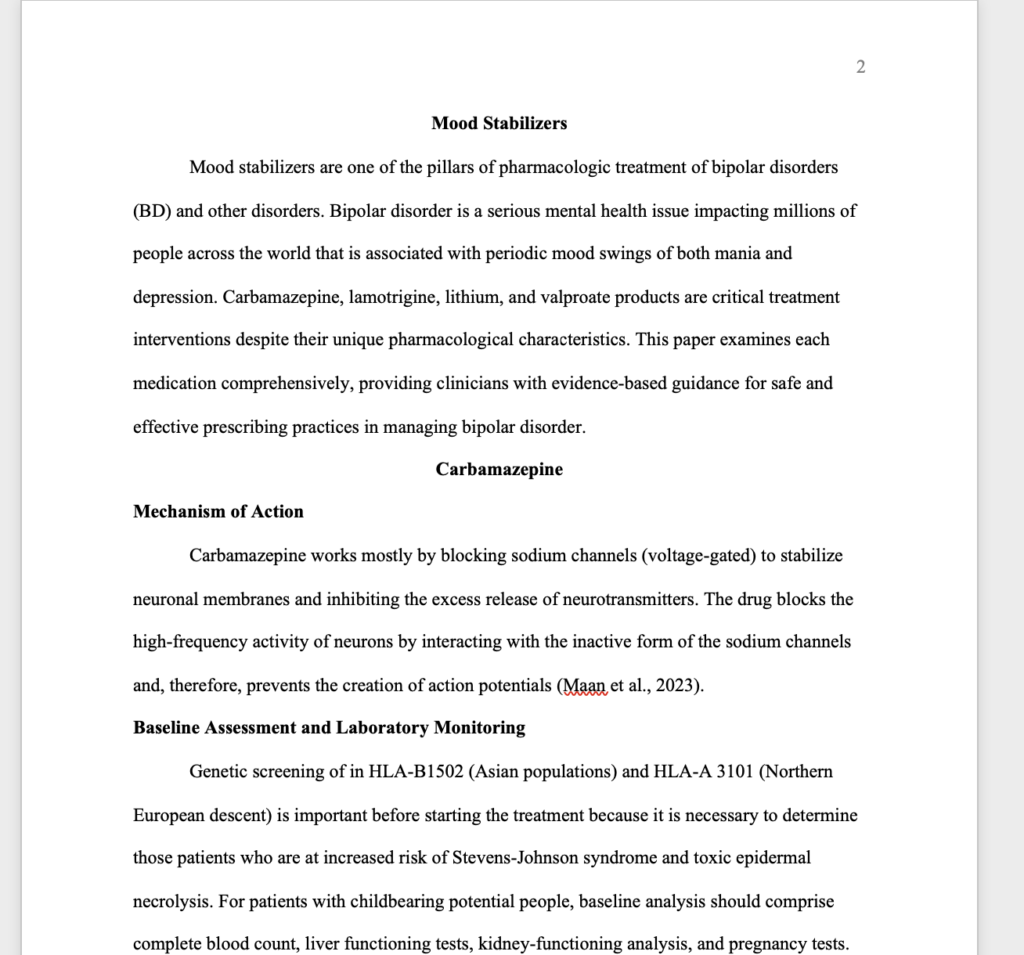
Mood stabilizers are one of the pillars of pharmacologic treatment of bipolar disorders (BD) and other disorders. Bipolar disorder is a serious mental health issue impacting millions of people across the world that is associated with periodic mood swings of both mania and depression. Carbamazepine, lamotrigine, lithium, and valproate products are critical treatment interventions despite their unique pharmacological characteristics. This paper examines each medication comprehensively, providing clinicians with evidence-based guidance for safe and effective prescribing practices in managing bipolar disorder.
Carbamazepine
Mechanism of Action
Carbamazepine works mostly by blocking sodium channels (voltage-gated) to stabilize neuronal membranes and inhibiting the excess release of neurotransmitters. The drug blocks the high-frequency activity of neurons by interacting with the inactive form of the sodium channels and, therefore, prevents the creation of action potentials (Maan et al., 2023).
Baseline Assessment and Laboratory Monitoring
Genetic screening of in HLA-B1502 (Asian populations) and HLA-A 3101 (Northern European descent) is important before starting the treatment because it is necessary to determine those patients who are at increased risk of Stevens-Johnson syndrome and toxic epidermal necrolysis. For patients with childbearing potential people, baseline analysis should comprise complete blood count, liver functioning tests, kidney-functioning analysis, and pregnancy tests. The therapeutic drug monitoring should be performed every week in the first eight weeks of treatment, then a regular correspondingly every three-six months in the cases of maintenance therapy (Maan et al., 2023).
Special Population Considerations
Carbamazepine is a significant teratogen, and it results in spina bifida, neural tube defects, cleft lip and palate. Those who can get pregnant need extensive counseling in terms of fetus risks and effective birth control (Al Khalili et al., 2020). The drug is associated with specific issues in geriatrics because it is more prone to bone marrow syndrome, hyponatremia caused by SIADH, and cardiac conduction disorders. Hepatic impairment patients must receive close dose modifications and increased monitoring due to the wide hepatic clearance of the drug.
FDA Approval and Dosing
Carbamazepine is approved by FDA as an adjunctive drug or monotherapy in acute manic and mixed episodes when dealing with bipolar I disorder. The starting dosage is 200mg twice a day in adults, and the dosage is gradually increased to therapeutic levels of 600-1600mg per day in divided doses. The endpoints in the therapy are reduction in symptoms and maintenance of euthymia as well as serum levels that are associated with clinical response and not numeric thresholds because they predict efficacy worse than other mood stabilizers (Al Khalili et al., 2020).
Major Drug Interactions
The strong CYP3A4 induction of Carbamazepine provokes a wide drug interaction potential. Lurasidone should not be used together because carbamazepine decreases the concentration of lurasidone by around eighty percent and, therefore, makes it ineffective. Grapefruit juice and its effects should not be confined to patients, as it acts on intestinal CYP3A4, resulting in an increased carbamazepine bioavailability of off-label and leading to the toxicity symptoms in the form of ataxia, diplopia, and cognitive impairment (Al Khalili et al., 2020).
Lamotrigine
Mechanism of Action
Lamotrigine is a selective binding and inhibitor of voltage-gated sodium channels that stabilize the membrane of the presynaptic neurons and suppress the release of glutamate and aspartate. Lamotrigine unlike other mood stabilizers has been shown to exhibit selective response to depressive episodes as compared to mania. The drug has the effects of use-dependent blocking of sodium channels, which can suppress supranormal neuronal processes of bipolar pathophysiology (Betchel & Saadabadi, 2023).
Baseline Assessment and Laboratory Monitoring
The baseline assessment must include a detailed medical history that includes a search of prior hypersensitivity reactions, assessment of liver functioning, and pregnancy. Lamotrigine normally does not need routine therapeutic drug surveillance as serum levels are not predictive of clinical reaction as they are expected to be where many other mood stabilizers. Nevertheless, the danger of the patient requires special dermatological monitoring, especially in titration stages when the risk of serious rash is the most significant. Clinical monitoring focuses on evaluation of symptoms, mood charts and assessment of any adverse effects such as dizziness, headache and coordination problems (Betchel & Saadabadi, 2023).
Special Population Considerations
Lamotrigine is identified as one of the conventional mood stabilizers exhibiting rather positive reproductive safety about which extensive risk-benefit debates should be held. Patients under estrogen-containing birth control drugs have lower glucuronidation levels, which could impair the control of hormone seizure or mood swings. On the other hand, progesterone-only
Add to cart to get full solution
Related: (Completed)NURS 6630 Week 9 Blog Substance Use, Addiction/Impulse Control Disorder

Reviews
There are no reviews yet.