
Description
NRNP 6635 Week 4 Assignment Assessing and Diagnosing Patients With Anxiety Disorders PTSD and OCD
“Fear,” according to the DSM-5-TR, “is the emotional response to real or perceived imminent threat, whereas anxiety is anticipation of future threat” (APA, 2022). All anxiety disorders contain some degree of fear or anxiety symptoms (often in combination with avoidant behaviors), although their causes and severity differ. Trauma-related disorders may also, but not necessarily, contain fear and anxiety symptoms, but their primary distinguishing criterion is exposure to a traumatic event. Trauma can occur at any point in life. It might not surprise you to discover that traumatic events are likely to have a greater effect on children than on adults. Early-life traumatic experiences, such as childhood sexual abuse, may influence the physiology of the developing brain. Later in life, there is a chronic hyperarousal of the stress response, making the individual vulnerable to further stress and stress-related disease.
For this Assignment, you practice assessing and diagnosing patients with anxiety disorders, PTSD, and OCD. Review the DSM-5-TR criteria for the disorders within these classifications before you get started, as you will be asked to justify your differential diagnosis with DSM-5-TR criteria.
Resources
Be sure to review the Learning Resources before completing this activity.
Click the weekly resources link to access the resources.
To Prepare:
- Review this week’s Learning Resources and consider the insights they provide about assessing and diagnosing anxiety, obsessive-compulsive, and trauma- and stressor-related disorders.
- Download the Comprehensive Psychiatric Evaluation Template, which you will use to complete this Assignment. Also review the Comprehensive Psychiatric Evaluation Exemplar to see an example of a completed evaluation document.
- By Day 1 of this week, select a specific video case study to use for this Assignment from the Video Case Selections choices in the Learning Resources. View your assigned video case and review the additional data for the case in the “Case History Reports” document, keeping the requirements of the evaluation template in mind.
- Consider what history would be necessary to collect from this patient.
- Consider what interview questions you would need to ask this patient.
- Identify at least three possible differential diagnoses for the patient.
By Day 7 of Week 4
Complete and submit your Comprehensive Psychiatric Evaluation, including your differential diagnosis and critical-thinking process to formulate primary diagnosis.
Incorporate the following into your responses in the template:
- Subjective: What details did the patient provide regarding their chief complaint and symptomology to derive your differential diagnosis? What is the duration and severity of their symptoms? How are their symptoms impacting their functioning in life?
- Objective: What observations did you make during the psychiatric assessment?
- Assessment: Discuss the patient’s mental status examination results. What were your differential diagnoses? Provide a minimum of three possible diagnoses with supporting evidence, listed in order from highest priority to lowest priority. Compare the DSM-5-TR diagnostic criteria for each differential diagnosis and explain what DSM-5-TR criteria rules out the differential diagnosis to find an accurate diagnosis. Explain the critical-thinking process that led you to the primary diagnosis you selected. Include pertinent positives and pertinent negatives for the specific patient case.
- Reflection notes: What would you do differently with this client if you could conduct the session over? Also include in your reflection a discussion related to legal/ethical considerations (demonstrate critical thinking beyond confidentiality and consent for treatment!), health promotion and disease prevention taking into consideration patient factors (such as age, ethnic group, etc.), PMH, and other risk factors (e.g., socioeconomic, cultural background, etc.).
Solution: NRNP 6635 Week 4 Assignment Assessing and Diagnosing Patients With Anxiety Disorders PTSD and OCD
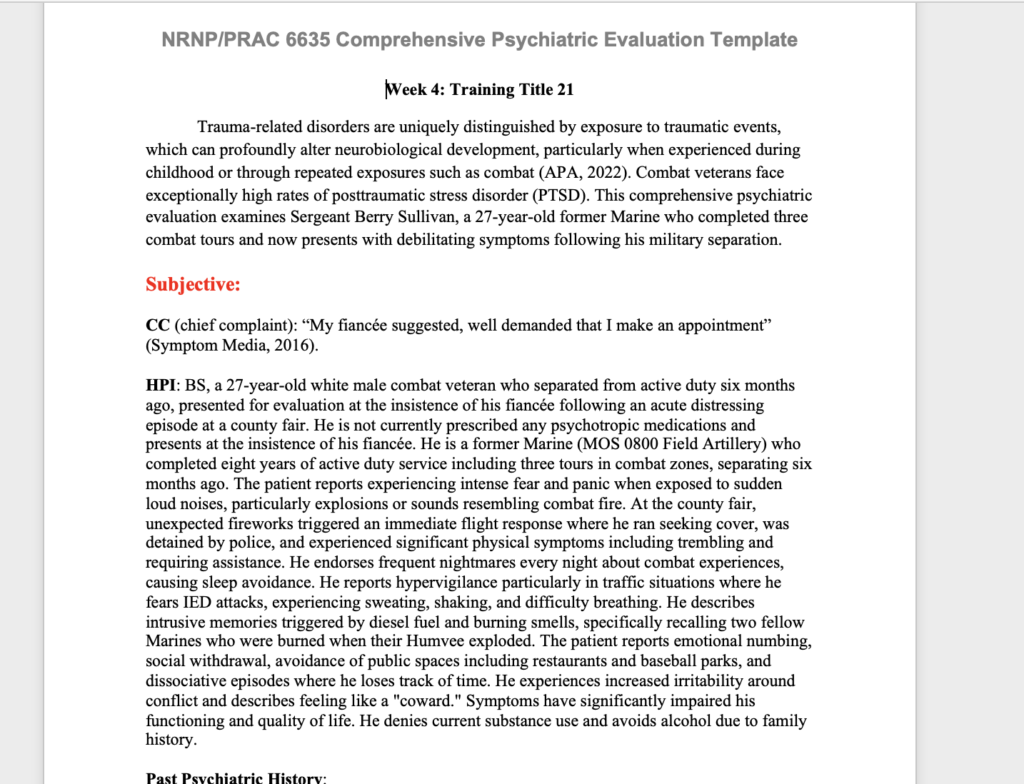
Week 4: Training Title 21
Trauma-related disorders are uniquely distinguished by exposure to traumatic events, which can profoundly alter neurobiological development, particularly when experienced during childhood or through repeated exposures such as combat (APA, 2022). Combat veterans face exceptionally high rates of posttraumatic stress disorder (PTSD). This comprehensive psychiatric evaluation examines Sergeant Berry Sullivan, a 27-year-old former Marine who completed three combat tours and now presents with debilitating symptoms following his military separation.
Subjective:
CC (chief complaint): “My fiancée suggested, well demanded that I make an appointment” (Symptom Media, 2016).
HPI: BS, a 27-year-old white male combat veteran who separated from active duty six months ago, presented for evaluation at the insistence of his fiancée following an acute distressing episode at a county fair. He is not currently prescribed any psychotropic medications and presents at the insistence of his fiancée. He is a former Marine (MOS 0800 Field Artillery) who completed eight years of active duty service including three tours in combat zones, separating six months ago. The patient reports experiencing intense fear and panic when exposed to sudden loud noises, particularly explosions or sounds resembling combat fire. At the county fair, unexpected fireworks triggered an immediate flight response where he ran seeking cover, was detained by police, and experienced significant physical symptoms including trembling and requiring assistance. He endorses frequent nightmares every night about combat experiences, causing sleep avoidance. He reports hypervigilance particularly in traffic situations where he fears IED attacks, experiencing sweating, shaking, and difficulty breathing. He describes intrusive memories triggered by diesel fuel and burning smells, specifically recalling two fellow Marines who were burned when their Humvee exploded. The patient reports emotional numbing, social withdrawal, avoidance of public spaces including restaurants and baseball parks, and dissociative episodes where he loses track of time. He experiences increased irritability around conflict and describes feeling like a “coward.” Symptoms have significantly impaired his functioning and quality of life. He denies current substance use and avoids alcohol due to family history.
Past Psychiatric History:
- General Statement: Patient denies any prior psychiatric treatment or diagnoses. This is his first mental health evaluation. He reports never seeking help for psychological symptoms despite completing three combat tours over eight years of military service.
- Caregivers (if applicable): Not applicable. Patient is independent and lives with his fiancée.
- Hospitalizations: No prior psychiatric hospitalizations.
- Medication trials: No previous psychotropic medication trials.
- Psychotherapy or Previous Psychiatric Diagnosis: No history of psychotherapy or formal psychiatric diagnoses. Patient has not previously engaged with mental health services despite serving in combat zones where mental health resources would have been available.
Substance Current Use and History: Patient denies any history of illicit drug use. He actively avoids alcohol consumption due to witnessing his father’s abusive behavior when intoxicated. Reports no tobacco use. No history of substance abuse treatment. Patient appears to have made conscious decision to abstain from substances that could lead to dependency, influenced by negative experiences with his father’s alcoholism.
Family Psychiatric/Substance Use History: BS reports a family history notable for paternal alcohol misuse associated with abusive behaviour. His father has chronic medical conditions including diabetes, cirrhosis, and hypertension and continues to drink. His paternal grandfather, also a veteran, experienced untreated depressive symptoms. No other psychiatric history was reported.
Psychosocial History: B.S. grew up in poverty and reports that military service provided an escape from limited opportunities. He enlisted in the Marines immediately after high school at age 18-19. Completed eight years of active duty service as Field Artillery (MOS 0800) with three deployments to combat zones. Separated from active duty six months ago. Currently engaged to be married in eight months. He and his fiancée relocated to a different state (approximately five hours from family) following his separation from military to support her career opportunity. Currently utilizing GI Bill benefits to pursue online degree in accounting. Lives with fiancée who appears to be supportive and concerned about his wellbeing. Plans to have children in the future. Reports stable relationship with fiancée despite current symptoms. Socially isolated at present, avoiding public spaces and social gatherings. No current employment mentioned; focused on education. No legal history mentioned beyond recent police encounter at county fair.
Medical History:
- Current Medications:
- Asthma medication (specific medication not stated, but service-connected)
- Allergy medications as needed for seasonal allergies (specific medications not stated)
- Allergies: Reports seasonal allergies.
- Reproductive Hx: 27-year-old male, engaged to be married in 8 months. Plans to have children with fiancée in the future. No children currently. No erectile dysfunction, libido changes, or other reproductive concerns mentioned.
ROS:
- GENERAL: Reports stable weight with no recent changes; denies fever, chills, persistent fatigue, or generalized weakness.
- HEENT: Eyes: Denies vision changes, eye pain, or photophobia. Ears, Nose, Throat: Denies hearing difficulty, nasal blockage, postnasal drip, or throat irritation.
- SKIN: Denies skin discoloration, rashes, or pruritus.
- CARDIOVASCULAR: Denies chest discomfort, irregular heartbeat, syncope, or swelling of the extremities.
- RESPIRATORY: Denies chronic cough, wheezing, or baseline dyspnoea.
- GASTROINTESTINAL: Denies abdominal pain, vomiting, diarrhoea, or gastrointestinal bleeding; notes intermittent nausea during periods of heightened anxiety.
- GENITOURINARY: Denies urinary frequency, pain with urination, difficulty initiating stream, or changes in urine appearance.
- NEUROLOGICAL: Denies headaches, seizures, dizziness, focal weakness, or sensory loss; no bowel or bladder incontinence.
- MUSCULOSKELETAL: Denies joint swelling, muscle soreness, back pain, or reduced range of motion.
- HEMATOLOGIC: Denies easy bruising, prolonged bleeding, or known blood disorders.
- LYMPHATIC: Denies swollen glands or recurrent infections; no history of splenic disease.
- ENDOCRINOLOGIC: Denies intolerance to temperature changes, excessive thirst, increased urination, or abnormal sweating
Objective:
T- 98.8 P- 86 R 18 B/P 122/7 Ht 5’8 Wt 160lbs
Physical exam: Not applicable
Diagnostic results:
No laboratory tests are currently recommended for diagnosing PTSD, as diagnosis relies primarily on clinical interview and standardized assessment tools. However, lab studies may be helpful in assessing for substance use disorders which commonly accompany PTSD. Thyroid function tests (TSH, free T4) should be obtained to rule out thyroid dysfunction, as thyroid

Reviews
There are no reviews yet.