
Description
NRNP 6635 Week 7 Assignment Assessing and Diagnosing Patients With Schizophrenia Other Psychotic Disorders and Medication-Induced Movement Disorders
Psychotic disorders and schizophrenia are some of the most complicated and challenging diagnoses in the DSM. The symptoms of psychotic disorders may appear quite vivid in some patients; with others, symptoms may be barely observable. Additionally, symptoms may overlap among disorders. For example, specific symptoms, such as neurocognitive impairments, social problems, and illusions may exist in patients with schizophrenia but are also contributing symptoms for other psychotic disorders.
For this Assignment, you will analyze a case study related to schizophrenia, another psychotic disorder, or a medication-induced movement disorder.
Resources
Be sure to review the Learning Resources before completing this activity.
Click the weekly resources link to access the resources.
To Prepare:
- Review this week’s Learning Resources and consider the insights they provide about assessing and diagnosing psychotic disorders. Consider whether experiences of psychosis-related symptoms are always indicative of a diagnosis of schizophrenia. Think about alternative diagnoses for psychosis-related symptoms.
- Download the Comprehensive Psychiatric Evaluation Template, which you will use to complete this Assignment. Also review the Comprehensive Psychiatric Evaluation Exemplar to see an example of a completed evaluation document.
- By Day 1 of this week, select a specific video case study to use for this Assignment from the Video Case Selections choices in the Learning Resources. View your assigned video case and review the additional data for the case in the “Case History Reports” document, keeping the requirements of the evaluation template in mind.
- Consider what history would be necessary to collect from this patient.
- Consider what interview questions you would need to ask this patient.
- Identify at least three possible differential diagnoses for the patient.
By Day 7 of Week 7
Complete and submit your Comprehensive Psychiatric Evaluation, including your differential diagnosis and critical-thinking process to formulate primary diagnosis.
Incorporate the following into your responses in the template:
- Subjective: What details did the patient provide regarding their chief complaint and symptomology to derive your differential diagnosis? What is the duration and severity of their symptoms? How are their symptoms impacting their functioning in life?
- Objective: What observations did you make during the psychiatric assessment?
- Assessment: Discuss the patient’s mental status examination results. What were your differential diagnoses? Provide a minimum of three possible diagnoses with supporting evidence, listed in order from highest priority to lowest priority. Compare the DSM-5-TR diagnostic criteria for each differential diagnosis and explain what DSM-5-TR criteria rules out the differential diagnosis to find an accurate diagnosis. Explain the critical-thinking process that led you to the primary diagnosis you selected. Include pertinent positives and pertinent negatives for the specific patient case.
- Reflection notes: What would you do differently with this client if you could conduct the session over? Also include in your reflection a discussion related to legal/ethical considerations (demonstrate critical thinking beyond confidentiality and consent for treatment!), health promotion and disease prevention taking into consideration patient factors (such as age, ethnic group, etc.), PMH, and other risk factors (e.g., socioeconomic, cultural background, etc.).
Solution:NRNP 6635 Week 7 Assignment Assessing and Diagnosing Patients With Schizophrenia Other Psychotic Disorders and Medication-Induced Movement Disorders
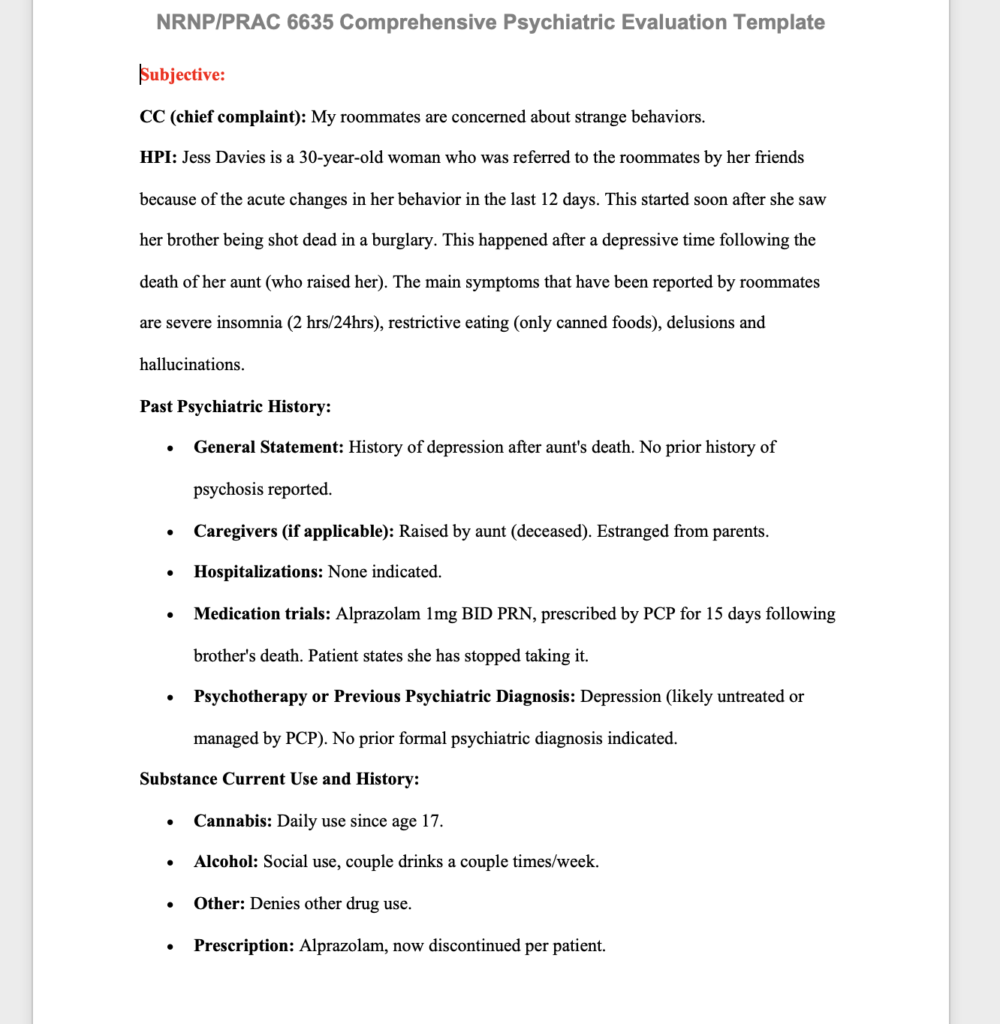
Subjective:
CC (chief complaint): My roommates are concerned about strange behaviors.
HPI: Jess Davies is a 30-year-old woman who was referred to the roommates by her friends because of the acute changes in her behavior in the last 12 days. This started soon after she saw her brother being shot dead in a burglary. This happened after a depressive time following the death of her aunt (who raised her). The main symptoms that have been reported by roommates are severe insomnia (2 hrs/24hrs), restrictive eating (only canned foods), delusions and hallucinations.
Past Psychiatric History:
- General Statement: History of depression after aunt’s death. No prior history of psychosis reported.
- Caregivers (if applicable): Raised by aunt (deceased). Estranged from parents.
- Hospitalizations: None indicated.
- Medication trials: Alprazolam 1mg BID PRN, prescribed by PCP for 15 days following brother’s death. Patient states she has stopped taking it.
- Psychotherapy or Previous Psychiatric Diagnosis: Depression (likely untreated or managed by PCP). No prior formal psychiatric diagnosis indicated.
Substance Current Use and History:
- Cannabis: Daily use since age 17.
- Alcohol: Social use, couple drinks a couple times/week.
- Other: Denies other drug use.
- Prescription: Alprazolam, now discontinued per patient.
Family Psychiatric/Substance Use History: Unknown due to estrangement from family. Brother (deceased) was only sibling.
Psychosocial History: Works in a bakery. He main social support is her two concerned roommates (Rachel, Liz), who are her roommates. She has a recent, severe trauma (witnessing brother’s homicide) and a previous trauma (loss of primary caregiver/aunt).
Medical History:
- Current Medications: Alprazolam 1mg BID PRN (patient reports discontinuation).
- Allergies: Medical tape.
- Reproductive Hx: Not provided.
ROS:
GENERAL: Sleep deprivation, decreased appetite (restrictive eating). Denies any weight change, fatigue, fever, chills or weakness.
HEENT: Denies headache, head trauma. Denies visual loss, blurred vision, double vision, or yellow sclerae. Denies hearing loss, sneezing, congestion, runny nose, sore throat.
SKIN: No rash or itching.
CARDIOVASCULAR: Denies any chest pain, chest pressure, or chest discomfort. No palpitations or edema.
Pulmonary: No dyspnea, coughing, or sputum.
GASTROINTESTINAL: Denies anorexia, nausea, vomiting, or diarrhea. No abdominal pain or blood.
GENITOURINARY: Denies burning on urination, urgency, hesitancy, odor, strange color.

Reviews
There are no reviews yet.