
Description
NRNP-6645 Week 7 Assignment Comparing Humanistic-Existential Psychotherapy with Other Approaches
Comparing Humanistic-Existential Psychotherapy with Other Approaches

Understanding the strengths of each type of therapy and which type of therapy is most appropriate for each patient is an essential skill of the psychiatric-mental health nurse practitioner. In this Assignment, you will compare humanistic-existential therapy to another psychotherapeutic approach. You will identify the strengths and challenges of each approach and describe expected potential outcomes.
Resources
Be sure to review the Learning Resources before completing this activity.
Click the weekly resources link to access the resources.
To prepare:
- Review the humanistic-existential psychotherapy videos in this week’s Learning Resources.
- Reflect on humanistic-existential psychotherapeutic approaches.
- Then, select another psychotherapeutic approach to compare with humanistic-existential psychotherapy. The approach you choose may be one you previously explored in the course or one you are familiar with and especially interested in.
The Assignment
In a 2- to 3-page paper, address the following:
- Briefly describe humanistic-existential psychotherapy and the second approach you selected.
- Explain at least three differences between these therapies. Include how these differences might impact your practice as a PMHNP.
- Focusing on one video you viewed, explain why humanistic-existential psychotherapy was utilized with the patient in the video and why it was the treatment of choice. Describe the expected potential outcome if the second approach had been used with the patient.
- Support your response with specific examples from this week’s media and at least three peer-reviewed, evidence-based sources. Explain why each of your supporting sources is considered scholarly. Attach the PDFs of your sources.
Solution: NRNP-6645 Week 7 Assignment Comparing Humanistic-Existential Psychotherapy with Other Approaches
Comparing Humanistic-Existential Psychotherapy with Other Approaches
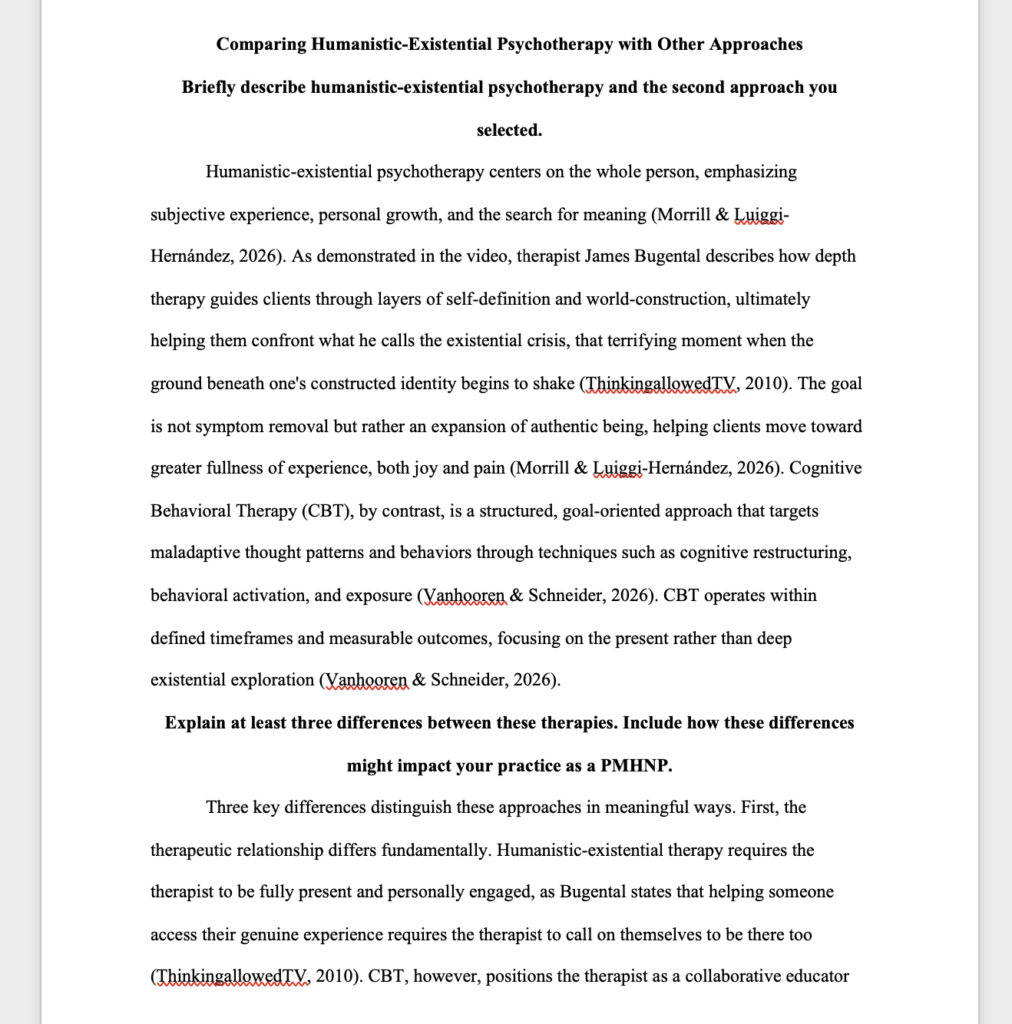
Briefly describe humanistic-existential psychotherapy and the second approach you selected.
Humanistic-existential psychotherapy centers on the whole person, emphasizing subjective experience, personal growth, and the search for meaning (Morrill & Luiggi-Hernández, 2026). As demonstrated in the video, therapist James Bugental describes how depth therapy guides clients through layers of self-definition and world-construction, ultimately helping them confront what he calls the existential crisis, that terrifying moment when the ground beneath one’s constructed identity begins to shake (ThinkingallowedTV, 2010). The goal is not symptom removal but rather an expansion of authentic being, helping clients move toward greater fullness of experience, both joy and pain (Morrill & Luiggi-Hernández, 2026). Cognitive Behavioral Therapy (CBT), by contrast, is a structured, goal-oriented approach that targets maladaptive thought patterns and behaviors through techniques such as cognitive restructuring, behavioral activation, and exposure (Vanhooren & Schneider, 2026). CBT operates within defined timeframes and measurable outcomes, focusing on the present rather than deep existential exploration (Vanhooren & Schneider, 2026).
Explain at least three differences between these therapies. Include how these differences might impact your practice as a PMHNP.
Three key differences distinguish these approaches in meaningful ways. First, the therapeutic relationship differs fundamentally. Humanistic-existential therapy requires the therapist to be fully present and personally engaged, as Bugental states that helping someone access their genuine experience requires the therapist to call on themselves to be there too (ThinkingallowedTV, 2010). CBT, however, positions the therapist as a collaborative educator
Add to cart to get full solution
Related:(Completed) NRNP-6645 Week 8 Assignment Psychotherapy for Clients With Addictive Disorders

Reviews
There are no reviews yet.