
Description
NRNP 6635 Week 8 Assignment Assessing and Diagnosing Patients With Substance-Related and Addictive Disorders
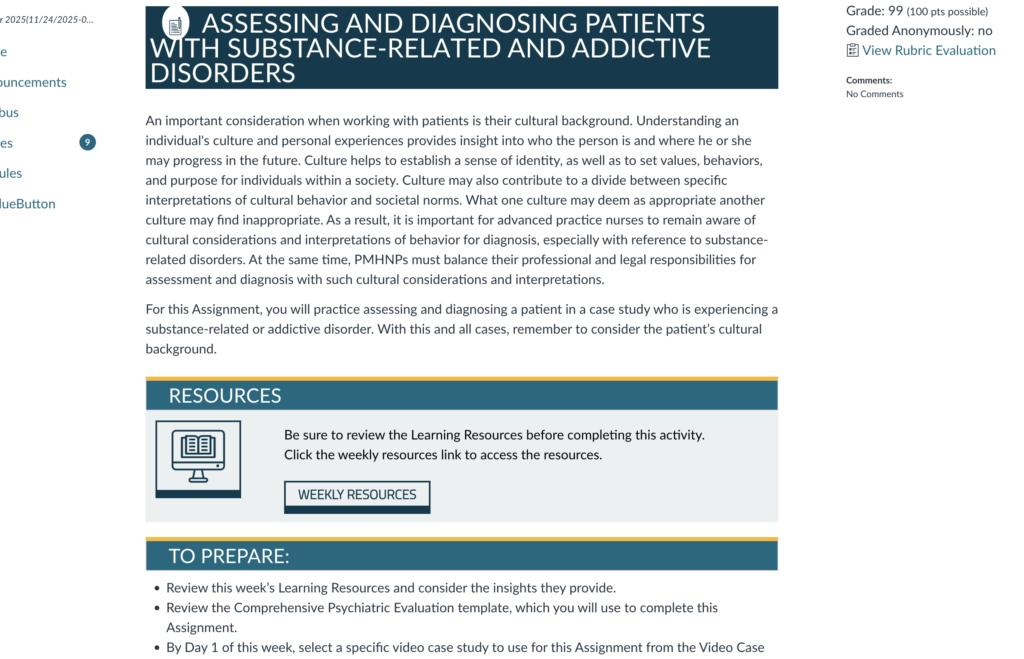
An important consideration when working with patients is their cultural background. Understanding an individual’s culture and personal experiences provides insight into who the person is and where he or she may progress in the future. Culture helps to establish a sense of identity, as well as to set values, behaviors, and purpose for individuals within a society. Culture may also contribute to a divide between specific interpretations of cultural behavior and societal norms. What one culture may deem as appropriate another culture may find inappropriate. As a result, it is important for advanced practice nurses to remain aware of cultural considerations and interpretations of behavior for diagnosis, especially with reference to substance-related disorders. At the same time, PMHNPs must balance their professional and legal responsibilities for assessment and diagnosis with such cultural considerations and interpretations.
For this Assignment, you will practice assessing and diagnosing a patient in a case study who is experiencing a substance-related or addictive disorder. With this and all cases, remember to consider the patient’s cultural background.
Resources
Be sure to review the Learning Resources before completing this activity.
Click the weekly resources link to access the resources.
To Prepare:
- Review this week’s Learning Resources and consider the insights they provide.
- Review the Comprehensive Psychiatric Evaluation template, which you will use to complete this Assignment.
- By Day 1 of this week, select a specific video case study to use for this Assignment from the Video Case Selections choices in the Learning Resources. View your assigned video case and review the additional data for the case in the “Case History Reports” document, keeping the requirements of the evaluation template in mind.
- Consider what history would be necessary to collect from this patient.
- Consider what interview questions you would need to ask this patient.
- Identify at least three possible differential diagnoses for the patient.
By Day 7 of Week 8
Complete and submit your Comprehensive Psychiatric Evaluation, including your differential diagnosis and critical-thinking process to formulate primary diagnosis.
Incorporate the following into your responses in the template:
- Subjective: What details did the patient provide regarding their chief complaint and symptomology to derive your differential diagnosis? What is the duration and severity of their symptoms? How are their symptoms impacting their functioning in life?
- Objective: What observations did you make during the psychiatric assessment?
- Assessment: Discuss the patient’s mental status examination results. What were your differential diagnoses? Provide a minimum of three possible diagnoses with supporting evidence, listed in order from highest priority to lowest priority. Compare the DSM-5-TR diagnostic criteria for each differential diagnosis and explain what DSM-5-TR criteria rules out the differential diagnosis to find an accurate diagnosis. Explain the critical-thinking process that led you to the primary diagnosis you selected. Include pertinent positives and pertinent negatives for the specific patient case.
- Reflection notes: What would you do differently with this client if you could conduct the session over? Also include in your reflection a discussion related to legal/ethical considerations (demonstrate critical thinking beyond confidentiality and consent for treatment!), health promotion and disease prevention taking into consideration patient factors (such as age, ethnic group, etc.), PMH, and other risk factors (e.g., socioeconomic, cultural background, etc.).
Solution: NRNP 6635 Week 8 Assignment Assessing and Diagnosing Patients With Substance-Related and Addictive Disorders
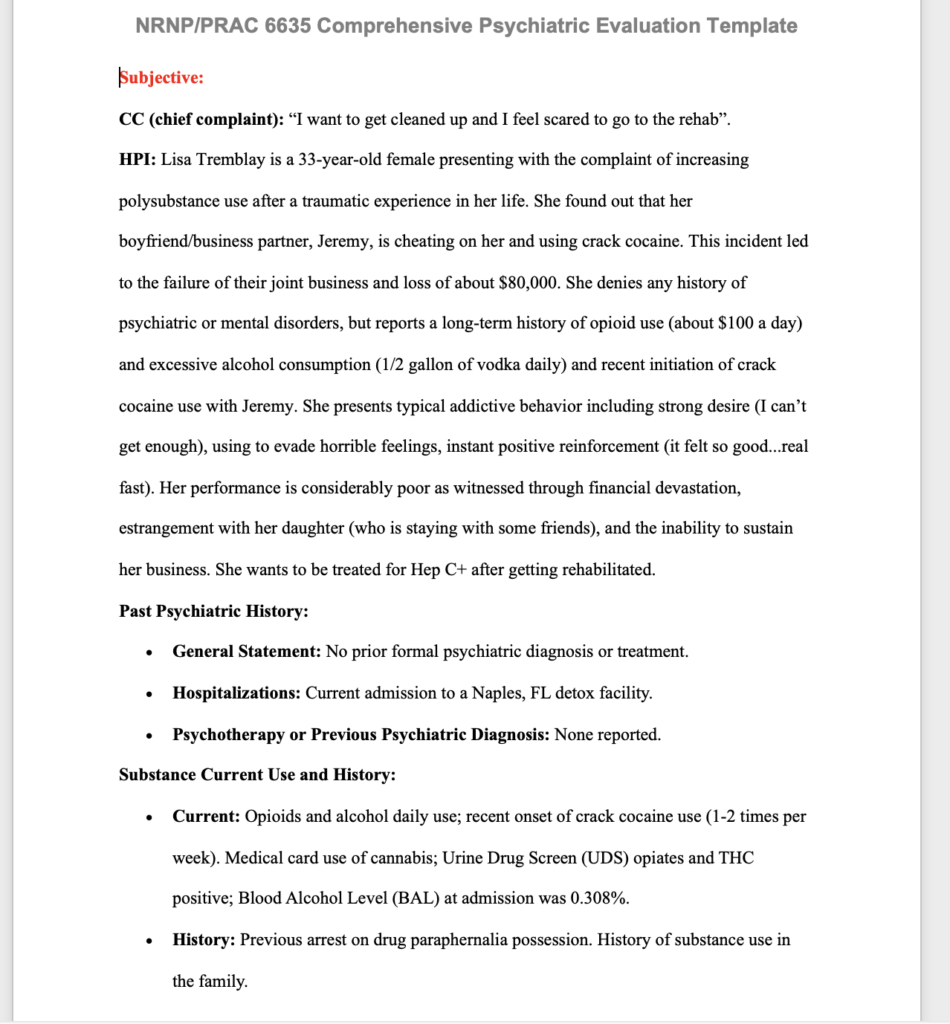
Subjective:
CC (chief complaint): “I want to get cleaned up and I feel scared to go to the rehab”.
HPI: Lisa Tremblay is a 33-year-old female presenting with the complaint of increasing polysubstance use after a traumatic experience in her life. She found out that her boyfriend/business partner, Jeremy, is cheating on her and using crack cocaine. This incident led to the failure of their joint business and loss of about $80,000. She denies any history of psychiatric or mental disorders, but reports a long-term history of opioid use (about $100 a day) and excessive alcohol consumption (1/2 gallon of vodka daily) and recent initiation of crack cocaine use with Jeremy. She presents typical addictive behavior including strong desire (I can’t get enough), using to evade horrible feelings, instant positive reinforcement (it felt so good…real fast). Her performance is considerably poor as witnessed through financial devastation, estrangement with her daughter (who is staying with some friends), and the inability to sustain her business. She wants to be treated for Hep C+ after getting rehabilitated.
Past Psychiatric History:
- General Statement:No prior formal psychiatric diagnosis or treatment.
- Hospitalizations:Current admission to a Naples, FL detox facility.
- Psychotherapy or Previous Psychiatric Diagnosis:None reported.
Substance Current Use and History:
- Current:Opioids and alcohol daily use; recent onset of crack cocaine use (1-2 times per week). Medical card use of cannabis; Urine Drug Screen (UDS) opiates and THC positive; Blood Alcohol Level (BAL) at admission was 0.308%.
- History:Previous arrest on drug paraphernalia possession. History of substance use in the family.
Family Psychiatric/Substance Use History: Mom has agoraphobia and benzodiazepine abuse history. Brother is older and has a history of opioid use and is not in contact with the family. Father was already imprisoned with crimes of childhood sexual abuse of the patient and drug charges.
Psychosocial History: Reports childhood sexual abuse by father since age 6-9, of which he was incarcerated. She is estranged from him. She is in a turbulent, dysfunctional relationship with Jeremy, where he cheats, financially exploits, and uses drugs together. She has a young daughter, Sarah, who does not live with her presently. She owned a small business together with Jeremy that has failed.
Medical History:
- Current Medications:None prescribed.
- Allergies:
- Reproductive Hx: Sexually active. Regular LMPs.
ROS:
- GENERAL:Sleeps 5-6 hrs., appetite poor, prefers to get high rather than eat. Denies chills, weakness, fatigue, or fever.
- HEENT: No headache. No visual issues (e.g. double vision, vision decline) reported. No hearing loss, sneezing, congestion, runny nose or sore throat.
Add to cart to full solution
Related: (Completed) NRNP 6635 Week 10 Assignment Neurocognitive and Neurodevelopmental Disorders

Reviews
There are no reviews yet.