
Description
NR511 Week 4 Midterm Exam
A 67-year-old male client presents to the clinic with several lesions that appear to be actinic keratosis. Which of the following statements is true?
Answers: A – D
- Actinic keratosis lesions are precursors to squamous cell carcinoma ✅
- Actinic keratosis is more common in individuals of Asian descent
- Actinic keratosis can be treated with topical steroids
- These lesions typically appear on areas of skin not exposed to the sun
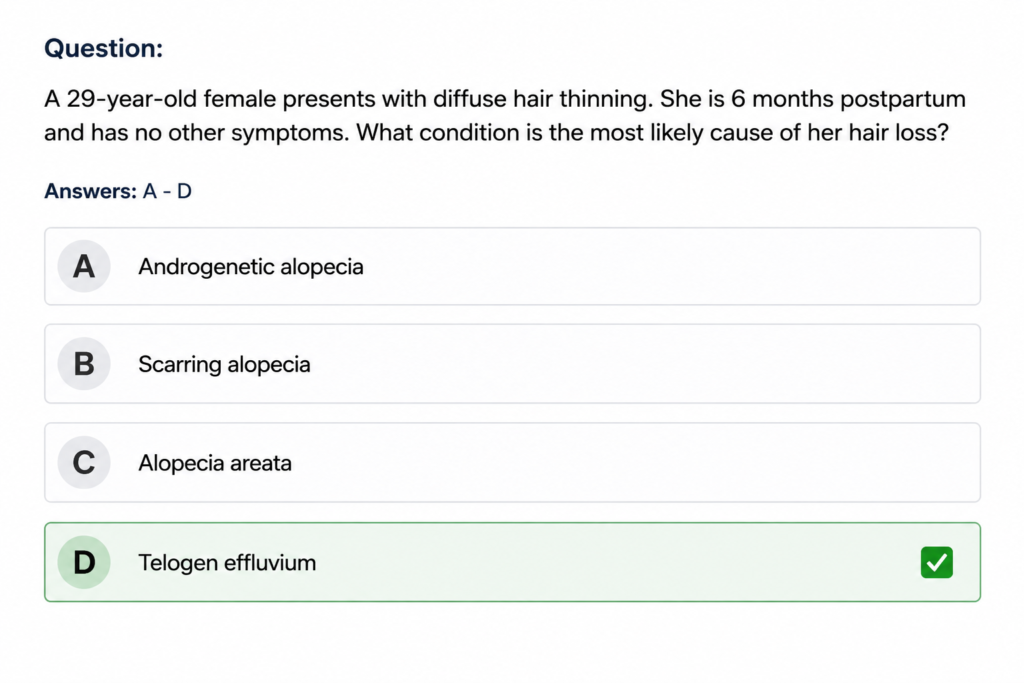
A 29-year-old female presents with diffuse hair thinning. She is 6 months postpartum and has no other symptoms. What condition is the most likely cause of her hair loss?
Answers: A – D
- Androgenetic alopecia
- Scarring alopecia
- Alopecia areata
- Telogen effluvium ✅
What is the purpose of the differential diagnosis in the clinical reasoning process?
Answers: A – D
- To establish a single working diagnosis
- To confirm a diagnosis using subjective data only
- To compare diagnostic test results to clinical symptoms
- To list potential diagnoses causing the client’s chief complaint ✅
A 4-year-old child is brought to the office by the parent with a complaint of sore throat, difficulty swallowing, copious oral secretions, respiratory difficulty, stridor, and a temperature of 102°F. No pharyngeal erythema or cough is noted. What is the most likely diagnosis?
Answers: A – D
- Epiglottitis ✅
- Peritonsillar abscess
- Tonsillitis
- Group A beta-hemolytic streptococcal pharyngitis
Which of the following is true regarding CPT Level II codes?
Answers: A – D
- They are used only for mental health billing codes
- They are updated every 10 years by the AMA
- They describe surgical procedures and inpatient care
- They are used to report non-physician services such as durable medical equipment ✅
The major premise on which Medicare Advantage (Part C) plans were designed is to:
Answers: A – D
- Replace original Medicare with a government-run alternative
- Reduce the role of private insurance companies in Medicare
- Eliminate the need for any out-of-pocket healthcare costs
- Provide beneficiaries with more choices and additional benefits beyond original Medicare ✅
A public health official is reviewing HIV epidemiological data in two regions. Region A has a higher prevalence of HIV among men who have sex with men (MSM), while Region B has a higher prevalence among intravenous drug users (IDUs). Both regions have implemented interventions focusing on condom distribution and safe sex education. Based on the risk factors in each region, which of the following best explains why the interventions may be less effective in reducing HIV transmission in Region B compared to Region A?
Answers: A – D
- Condom distribution does not address the primary mode of transmission in Region B ✅
- The population density in Region A makes interventions more effective compared to Region B
- IDUs in Region B are more likely to also engage in unprotected sex, which increases HIV transmission
- Safe-sex education is more effective in Region A because MSM are more likely to use condoms
What is the first-line antibiotic therapy for an adult with no known allergies and suspected group A beta-hemolytic streptococcal pharyngitis?
Answers: A – D
- Azithromycin
- Clindamycin
- Ceftriaxone
- Amoxicillin ✅
A 55-year-old patient presents to the office complaining of bilateral, high-pitched tinnitus. What assessment should the nurse practitioner perform FIRST?
Answers: A – D
- Complete hearing evaluation with tuning fork tests ✅
- Referral to otolaryngology for audiologic testing
- Full cranial nerve evaluation
- MRI of the brain and internal auditory canals
A patient reports to the office with “feeling of sand” in both eyes, blurry vision, burning and itching and complaint of foreign body sensation in both eyes. The physical exam reveals sensitivity to light and glossy appearance of the cornea. Based on the patient’s presentation and physical exam, what is the likely diagnosis?
Answers: A – D
- Hordeolum internum
- Dry eye syndrome ✅
- Chalazion
- Conjunctivitis
Which of the following information about non-pharmacologic management should be included in parent teaching for a child with impetigo?
Answers: A – D
- Gently wash lesions with soap and water to remove crusts ✅
- Allow child to share towels to prevent skin maceration
- Cover lesions with adhesive bandages to dry them out
- Apply warm compresses followed by topical steroid
A 55-year-old patient presents to the primary care clinic with sudden, painless loss of vision in the right eye that started an hour ago. The patient denies trauma but has a history of hypertension and diabetes. The nurse practitioner identifies no abnormalities of the external eye on inspection, including no redness or discharge. What is the nurse practitioner’s next step?
Answers: A – D
- Refer the patient to an ophthalmologist immediately ✅
- Start the patient on artificial tears and schedule a follow-up in one week
- Advise the patient to monitor symptoms and return if they worsen
- Prescribe antibiotic eye drops and reassess in 48 hours
A 70-year-old woman visits the audiology clinic for a hearing evaluation. She reports that over the past few years, she has noticed a gradual decrease in her ability to hear, particularly in noisy environments. She has difficulty understanding conversations, especially when multiple people are speaking at once. She also mentions that she often has to increase the volume on her television to hear clearly. The audiologist conducts a hearing test and notes a high-frequency sensorineural hearing loss. Which of the following is associated with presbycusis in this patient?
Answers: A – D
- Age-related changes in the auditory system ✅
- Acute otitis media
- Cerumen impaction
- Exposure to loud noises
A patient presents with right eye pain accompanied by tearing, photophobia, mucoid discharge, and conjunctival hyperemia. Upon examination, the cornea appears cloudy. What is the most likely diagnosis?
Answers: A – D
- Herpes zoster ophthalmicus
- Keratitis ✅
- Cataracts
- Corneal abrasion
A patient presents with localized tenderness and redness at the eyelid margin, accompanied by internal swelling. Considering the symptoms described, what is the most likely diagnosis?
Answers: A – D
- Hordeolum ✅
- Blepharitis
- Chalazion
- Conjunctivitis
A patient with cataracts asks the nurse practitioner if taking vitamin E, vitamin C and beta-carotene can help in their treatment. What is the best response by the nurse practitioner?
Answers: A – D
- There is no evidence to support the use of these supplements in the prevention or treatment of cataracts
- There is some evidence that these vitamins may help slow the progression of cataracts, but they will not reverse them. ✅
- Taking too much vitamin E supplement can lead to macular degeneration
- Vitamin C is the most effective of those supplements
In which part of the SOAP note would you include the diagnosis?
Answers: A – D
- Subjective
- Plan
- Assessment ✅
- Objective
Which of the following best describes how HIV is most commonly transmitted worldwide?
Answers: A – D
- Through casual contact, such as hugging and sharing utensils
- Through airborne particles
- Through unprotected sexual contact and sharing contaminated needles ✅
- Through mosquito bites in regions with high HIV prevalence
A school-aged child has just completed treatment for pediculosis (lice). The parent calls the nurse practitioner and indicates that the treatment was not successful because the child is still reporting itching. What is the BEST response by the nurse practitioner?
Answers: A – D
- “Itching following treatment indicates that the child was reinfested, therefore requiring treatment to be restarted”
- “Itching is a sign of an allergic reaction, and therefore another medication will need to be prescribed”
- “Itching following treatment is an indication that treatment failed, and retreatment must be initiated”
- “Itching can persist for up to a week following successful treatment due to inflammation from the lice infestation” ✅
When making clinical decisions based on the best available evidence, which of the following sources provides the highest level of reliability and least bias?
Answers: A – D
- Systematic review of the literature ✅
- Qualitative studies
- Randomized controlled trials
- Literature review
A 68-year-old patient reports a bright red spot located on the sclera of the right eye for 5 days. The patient denies any trauma to the eye or headaches. His past medical history is unremarkable except for chronic constipation treated with a laxative as needed. Which of the following is the most likely diagnosis?
Answers: A – D
- Corneal abrasion
B. Uveitis
C. Subconjunctival hemorrhage ✅
D. Pinguecula





Reviews
There are no reviews yet.